



Share:
Written by:
Tags:
``We want to level the playing field for everyone to enter Tech`` ~ Shilpi Agarwal
“We want to make these opportunities available for all students globally worldwide”
~ Shilpi Agarwal
I am text block. Click edit button to change this text. Lorem ipsum dolor sit amet, consectetur adipiscing elit. Ut elit tellus, luctus nec ullamcorper mattis, pulvinar dapibus leo.
For SCT and test prep
...the prices are even higher, they go up to about $100 an hour! ~ Shilpi Agarwal
I am text block. Click edit button to change this text. Lorem ipsum dolor sit amet, consectetur adipiscing elit. Ut elit tellus, luctus nec ullamcorper mattis, pulvinar dapibus leo.
“We want to have enough encouragement, support, and mentoring for students to be able to say yes to these opportunities, to say, Yes, I can do this!”
~ Shilpi Agarwal
Expand
About the talk
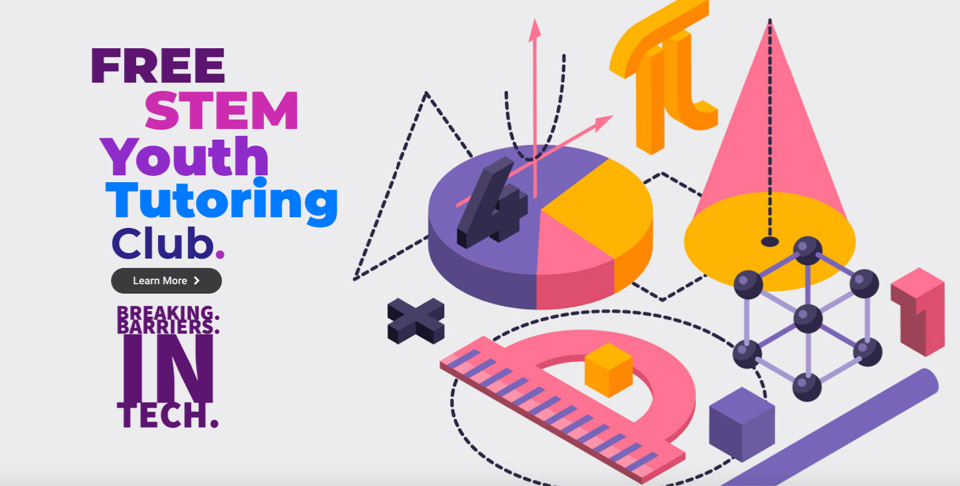
In this talk Shilpi Agarwal introduces DataEthics4All Free STEM Program for AI DIET World 2021. DataEthics4All is on a mission to level the playing field for entry into a tech career and to bring greater diversity to tech, by encouraging economically disadvantaged students to pursue STEM careers. To this end, DE4A has made the #5M5Y Pledge: aiming to provide leadership opportunities and support to 5 million economically disadvantaged students in the next 5 years. Support will range from free stem tutoring, and career technical education, to career guidance, free essay reviews for college applications and career technical education. Listen in on some of the great initiatives and exciting plans for the future, and hear how you can get involved to build a more fair and diverse tech landscape and society!
Transcription
0:04
Hello, everyone, sorry about the technical difficulties, we are back live. And I wanted to share the DataEthics4All story and the free stem program that we have.
0:24
So as you know DataEthics4All is breaking barriers of entry in tech, that’s our biggest motto. We want to level the playing field for everyone to enter tech. Really make it easy. As you know, tech careers are one of the highest paying careers today. And like, you know, in Linda’s talk, she said once a child joins, or even in Mike’s talk today in the morning he said, hiring is such an important decision that changes the trajectory of not just that one person, but everyone around them. And I feel hiring is one such thing. But even before that education, also is the precursor to hiring changes your entire trajectory for yourself, your family and for generations to come. And so for students who are not economically, as privileged as some of the others who are economically disadvantaged, they are the first in their family to go to college, or first in their family to have an education, finish high school, they are naturally disadvantaged too. And if they are not encouraged to take on STEM careers and no role models or help in STEM fields; and if they lose interest in math and science early on, they are not going to choose STEM careers in their life, which is again going to affect the trajectory that they will be on. And so DataEthics4All l wants to change all that, level the playing field for everyone involved and for, for everyone to be able to really take on the stem as a career in life.
“Whether it’s a linear stem path or a nonlinear stem path, we want to make these opportunities available for all students globally worldwide.”
2:17
And so with that, I want to share a little bit. Yesterday, I shared the story of how DataEthics4All started, and how in less than two years with our leadership team, with the strong team of volunteers, with a strong team of our youth AI council, we have managed to make great strides and come to where we are today. And our work is not done, we have just begun.
“So last year, around Thanksgiving, we made a pledge of 5 year pledge to help 5 million economically disadvantaged students with leadership opportunities, free stem mentoring, career guidance, career technical education, essay writing, and lots of other things at no cost to students.”
And our goal, as I said, is to break barriers of entry in tech, build diversity in society, and to build a more equitable society. And we think that starting this at the grassroots level, we are introducing this program with sixth grade to 12th-grade students.
But as we are successful, and we build upon the success of this program, we want to even introduce this program to elementary school students. Because in our school here in sixth grade, there is a path which you can take a sixth grade regular math or an exponential math, six-plus. And then the seventh grade, you do seventh and eighth-grade math, or you just do seventh-grade math. So the trajectory changes from sixth grade onwards for somebody who enjoys math and science versus somebody who is just taking the course requirement at that level.
“And so we want to have enough encouragement, support and mentoring 40 students to be able to say yes to these opportunities. Yes to say, yes, I can do this. I love math, I am good at math, and I enjoy doing math. Math is easy. Math is fun.”
Those are the kinds of things and not just math. In sixth grade obviously it’s math, but and science but then it leads to a different like calculus A, B, B, C, and even AP classes, and even the chemistry honors all these honors and AP courses and all these computer programming courses, all of that starts from middle school, but then it in high school it really takes off biology, chemistry, calculus, pre-calculus, trigonometry. So all of these things are important that you know we set the ground rules, and help our kids be comfortable to ask questions and be able to find mentors that they can rely on.
5:16
So why exactly did DataEthics4All decide to start this program? Our AI Youth Council data ethics for all AI Youth Council, our team of dedicated youth leaders, Ronak Agarwal, and many of the other people who are in the leadership, Sarah Ghorbani. And all of these students came up to us and said, that, you know, they feel like, and this was right in the middle of the pandemic, and they felt like starting a tutoring program for students would be a good way to help give support to students who are falling behind.
More so in a pandemic because there is no help from teachers, they are not actually going to school, and so they cannot actually ask the teacher. Yes, there are all these tools available, that you can book a private time with your teacher to do all these things, but it was so difficult, it’s so difficult for students in person doing that, so imagine how difficult it must be for them to do it online and to ask for extra support online. And so, if you look at tutors.com…and so what is the alternative that may be augmented or supplemented with, supplement it with a professional tutor who can help these students.
“But tutoring is expensive and on average private tutors cost between $25 to $80 an hour. And for SCT and test prep, prep tutoring, the prices are even higher, they go up to about $100 an hour.”
And this is just online and if you go to an in-person tutoring center the prices are even higher, they are $250 to $200 an hour. And we know that it’s a stretch for some of our families to pay that kind of money for tutoring.
“Also, high poverty school districts get $1,200 less per student than affiliated school districts according to an address report. So if schools are not getting enough funding, their students are deprived of opportunities to learn at the same level as their counterparts.”
Smaller budgets mean less access to STEM-related resources, projects, technologies, and just driving interest and curiosity at this age, which is required for students. They cannot participate in robotics programs and all of that which costs, unfortunately.
8:03
So introducing our 10 pillars free stem program. Initially, as I said, we started the DataEthics4All STEM program through our youth council just offering free stem tutoring. Overtime when we spoke to many many schools today we are working on, I’ll show you, we are working with over 30 schools. And we have many youth volunteers and tutors who are willing to support and tutor their peers while they are on presidential volunteer hours for the community service. But it comes from a place of you know, helping others. And that is, I think they’re doing a great job with this grassroots of creating this desire and this privilege to help others. And so we started with just a free stem tutoring program, but I’m talking with these schools and the administrative staff of the schools, we quickly learned that most schools do offer some kind of homework help and support to students, especially for homework. Whether there is a homework center inside of school during recess time or during the lunch hour, some of them offer it after school at a dedicated time, but some kind of homework help is there.
“What our free stem tutoring program was doing or is doing is to help these students at any time based on their schedule and availability because some of these students are also working to support their families, or they’re taking care of their sibling while their parents work multiple jobs. So these kids are busy and they don’t have dedicated time to spend after school on learning. And so our program does that for them.”
10:00
But apart from that, what we realize is that there is a definitive gap in terms of career mentoring from counsel guidance and counselors in school. Because the caseload is so high for the school counselors at school and they are not able to give the personal, either one on one or even one to group attention to all these questions and career paths that students can be exposed to today, and they are available even linear and nonlinear stem paths that are available for our students today.
“Career counselors, unfortunately, do not have the time to go over those with every student. And so we’ve really felt that there is a big need, and a gap, for students to be offered career mentoring.”
And because DataEthics4All has a community of over 1000 leaders who are global and who are at the intersection of policy, data ethics, technology and social impact, they are the perfect role models and mentors who can help these students really not just talk about like a career day, but to actually come and have either a one to one or one to group talk with them, and project-based career mentoring with them
“And walk them through what it looks like to be an engineer, what does it look like to be a data analyst? What do they do on a daily basis? What are the five things that a stem and AI and ml engineer does on a daily basis, in his role in his job or her job today?”
11:42
So all of these are questions that our students are asking. And this program, the DataEthics4All 10 pillars program of our free stamp really helps them. Like number one is the stem career tutoring. Number two is career mentoring. Then we have project-based career mentoring, as I mentioned. We do offer career advice, one-to-one as well as one to group. We also have essay reviews, because as anybody who has gone through this high school and college application process, it really is a lot and it’s overwhelming. Just the amount of and the number of essays that you have to write the creations that you have to go to the common apps that you have two essays, number of essays that you have to write in the common app. It’s mind-boggling. And then your admission depends a lot on that not just on grades or your scores, but also on how your writing skills and your communication skills, and how well you have made an effort to the storytelling to put yourself out there, all those things matter. And so a little bit of help in that area could go a long way. And that’s why there is support and help that you would love to offer.
“Career Technical Education we have introduced again, I can’t rave enough about our AI Ethics Youth Council because they have actually developed three introductory courses, peer to peer courses.”
And I’ll share that in a minute on Introduction to AI ethics as well as data science. And they are available in our Data Ethics Institute to be taken for free, and on a certificate of completion. And also you can post it on your college application saying you have earned a certificate of completion on these courses through DataEthics4All.
13:42
Besides that, we also offer internships, summer internships and winter internships and anybody who has tried for themselves or their child to get business or tech internships for under 16 you might know that it is very hard and most companies are not willing to give that kind of role to students. And of course, it is very hard for us also because the students are young, and they don’t have that much experience, and there is a lot of hand-holding that needs to be done.
But we take on that as a challenge because this is an area this is a place where they can come feel a part of a community, get mentoring, look, connect with their peers, and also actually acquire the business and technical skills for an internship period. And just this summer, we have had over 18 students as summer interns, some Oxford scholars and high school interns
“This intern, high school intern in particular has on the silver because of the two months internship that he did with us he was able to collect and accumulate his volunteer hours and earn the silver medal of presidential Volunteer Service Award with us.”
And so this is a fantastic opportunity to learn new skills and build your resume up. And to get fabulous college recommendations. Obviously, just like school, we don’t do it for everyone. But based on performance, yes, we do.
15:16
We also offer leadership opportunities our youth. Basically, they can volunteer with us and on the presidential Volunteer Service Award, they can start DataEthics4All club at their school, or their college. And basically, they can take the mission forward, start town hall discussions, bring courses, mentoring and career advice to their students. Everything that we do on the global platform online on DataEthics4All can be taken in person and be done. And we do have some youth leaders who have started these clubs at their school. And this is our first year doing that. And so next year, I’ll come back and tell you how many clubs we have and how that is going. So that is an ongoing effort. And we are really proud that we have started this.
16:10
So this is our 10 pillar program. And it’s a running joke in our team like we are always saying we have the pillars, we have the pillars for our, you know, our principles, our ethical principles, and now we have the 10 pillars for free stem program. So yes, we do have the pillars, because we feel like pillars are the most important step of the foundation, of a building. So we have the pillars, but now we invite you to come build with us.
“Come help build this bright future for our kids, and for the kids of our society. Come work with us, mentor with us, volunteer with us, help us build the next generation of ethics for leaders.”
16:55
And very quickly, I think we are already over time. So I’m going to breeze through these slides, which is telling you about you know, we have a dedicated free stem tutoring website where people can come with parents and students looking to be tutors to get to drink and sort on the subject, they need help. And they can pick the tutor that they like based on their personality and their geographic location. And they can go from there.
17:30
And like I mentioned our youth mentoring program, we are just starting this. There are many different ways of mentoring. So if you are willing to share your time and your expertise, please come and talk to one of us from the leadership team.
“We would love to have you as a mentor to our students. And we have different kinds of one to one group and project-based mentoring.”
17:51
These are the three courses that I was talking about AI Youth Council has developed. This is Introduction to Data and Artificial Intelligence, bias in data, as well as Tech Impact on youth.
And they have many other courses in the pipeline. We have designed many other things that we want. But we want to first see the results of this like how some of the students who have taken these courses and completed the certification have said good things about these courses that they learnt a lot. And now they feel equipped to understand what are the basics of this. So I would highly recommend all the students in your life to encourage them to do this is for at the high school level, these courses are designed for middle and high schoolers, so please encourage them to take this.
We have partnered with Oxford University and with the University of North Texas to again provide internship opportunities and to bring these linear and nonlinear STEM career paths for our students.
And we have hosted over 18 Oxford summer interns. So here are some things that our students are saying our interns are saying. You can read more on our website. This is the high schooler that I mentioned Devon Thomas, as well as our Sarra Hannachi she is from the University of Tunis.
19:17
These are some of the schools that we are working with.
“We have partnered with over not partnered but we are really working with more than 30 schools and their youth for tutors, volunteers in some way or the other.”
We are working with a lot of different schools. If you can help us connect with some schools and bring this program, you think DataEthics4All STEM programs will help students from your school. Please help us connect with them. These are some of the Presidential Awards that our students have on volunteers earned. There is an actual letter from the president, there is an actual medal that comes from the president’s office desk.
“So how much money do we need. We really need your support. And like I said, online tutoring costs 25 to $50 an hour. And if we want to support 5 million students, in five years, that’s going to be a big number.”
Even if we considered 80% of our tutors would be volunteers, and only 20% of our tutors would be paid, because we want this to be an additional source of revenue for the tutors themselves, as well as for representation of, you know, economically disadvantaged students to see that there are others, other leaders in the industry like themselves. So we want this to be and also for consistency. If we have paid tutors on staff, then there is a consistency in the life of a student, because we can say that these are the days that our student wants to be tutored. So all of that we need your help and support in that.
“And your support really goes a long way because $1,000 pays for STEM tutoring for one student for one year at the rate of $25 an hour. $5,000 pays for career counselling, college applications. $8800 pays for high school rising senior to get some paid summer internship. And a $10,000 pays for courier counselling college application process for high school students for the entire four years of high school.”
21:38
And this is just a small glimpse of you know what we need and how much we want to do for the community. And every penny helps. These are some of the programs that I briefly mentioned the things that we have done in less than two years.
“Our youth have been a constant center at all of these programs, whether it’s from town halls, to the institute. We had the summit last year where we had a fantastic panel on how social stigmas instigate racial injustice and it was a mixed panel of adults and youth.”
22:20
…Yeah, perfect. Okay. I’m going to wrap this up really quickly with the statement that you know, with your love and support of DataEthics4All what started as a small dream and initiative has grown, it has taken roots and it has really become a movement. And with that support, we have decided to start a new company called the DE4A Foundation, which is a Delaware public corporation benefit corporation with missions rooted deeply with the same mission of helping others and building strong STEM grassroots for everyone.
23:12
And with that, I’m going to say bye, and I’m going to welcome my next guest. Thank you everyone for listening.


DataEthics4All hosted AI DIET World, a Premiere B2B Event to Celebrate Ethics 1st minded People, Companies and Products on October 20-22, 2021 where DIET stands for Data and Diversity, Inclusion and Impact, Ethics and Equity, Teams and Technology.
AI DIET World was a 3 Day Celebration: Champions Day, Career Fair and Solutions Hack.
AI DIET World 2021 also featured Senior Leaders from Salesforce, Google, CannonDesign and Data Science Central among others.
For Media Inquires, Please email us [email protected]
Come, Let’s Build a Better AI World Together!
Share:
Written by:
Tags:
``The next mantra is to fail and fail fast....
What that means is it's okay to fail have that mindset, but do it fast so that you can iterate`` - Mahesh Mohan Thakur
“You got to have the knowledge about how things work, how things are evolving. What does that look like? And then educate yourself.”
~ Mahesh Mohan Thakur
I am text block. Click edit button to change this text. Lorem ipsum dolor sit amet, consectetur adipiscing elit. Ut elit tellus, luctus nec ullamcorper mattis, pulvinar dapibus leo.
“Culture is a very critical aspect of making sure technology or even AI advancement happens.”
~ Mahesh Mohan Thakur
Expand
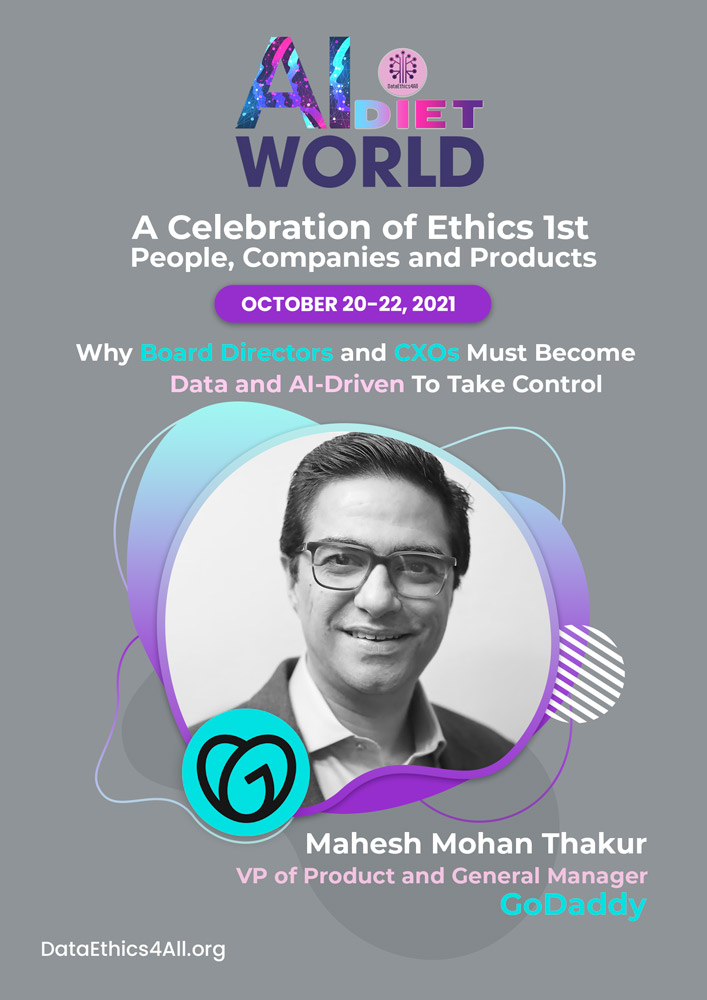
In this talk, we will discuss how Data and AI-Driven organizations become successful. We will review the 5 ways in which CEOs, CPOs, and CDO’s can deliver high impact and growth for their organization. Mahesh M. Thakur is a technology executive, Board Member, and CEO advisor with 20+ years of experience building and scaling teams at Microsoft, Amazon, Intuit, Intel, and a startup. Mahesh is a guest lecturer at Columbia and NYU. Mahesh has hired, coached, and transformed executives and teams at some of the world’s fastest-growing companies.
Expand
0:52
Hello Starting with Mahesh Mohan Thakur from GoDaddy. Let me introduce him and then we’ll bring him on stage.
1:13
Mahesh is a technology executive, a board member, and a CEO Advisor with 20 plus years of experience building and scaling teams at Microsoft, Amazon, and even a startup Mahesh is a guest lecturer at Columbia and NYU. He has hired, coached, and transformed executives and teams at some of the world’s fastest-growing, please put your hands together. To welcome Mahesh, Oh, hey, morning. Good morning. For pleasure and an honor to be here with you. Thank you for having me. Thank you. My stages are large. I’m so excited to hear about so much of your experience. I’m excited to hear how CXOs can adopt AI and deliver impact. Go for less. Thank you. Happy to chat with you folks about it. I’m just getting my screen to be shared here in a second. Give me one moment. And you guys see my screen on the stage. Okay, awesome. So I’ll get started assuming the video audio and the slides are together. So I’m excited to speak here today on how AI-driven CEOs and board members truly deliver impact in today’s day and age. I’ll be sharing broadly three mantras for law and policy. The three mantras are as follows To simplify fast and lastly, the goodness factor. And I’m talking about you know-how in today’s day and age, there are several companies and the landscape is very broad. It is about the tape.
“There are traditional companies which are 100 to 200 years old. And there are these startups that are being born today which are called Digital First or in some cases digital from the broad spectrum of companies and when I get to work with these amazing board members and CXOs of these companies.”
3:38
I have studied India journey so today a lot of these observations and also you know give you some key nuggets on the challenges that I’ve seen when I’ve worked including Microsoft, shared with you what has worked, what has not worked, and hopefully, we’ll have some time to answer questions. So without further ado, let’s get started. I’m going to talk first about simplifying with simplification. I would love to share something which I keep repeating and I keep coming across this more and more as I coach more senior folks. I remind them number one AI in and of itself cannot be a strategy for the business.
“Yeah is not something which you say okay, my strategy to win this market is let’s just implement AI. That’s never going to be the right approach. Nor is that going to fly with any seasoned board member.”
The way to approach it is my goal or my vision is to win this market share or have 50% market share for our products for our owners to lower the attrition of our customers from 30%. That’s your business strategy.
And to do that, you may now want to implement AI. So if you bring in AI to solve a business problem, and when you talk about the approach, that’s the right way to think about and that’s why I continue to articulate and remind folks that
“Just having AI is not going to help you in business or when your customers you have to have an understanding of how that technology is going to help you with their business or their business strategy.”
The next observational point here is not a project, but an investment for the long term. What this means is we don’t want to have projects. We’ll say let’s start this for a year and see where it goes. Or let’s monitor this every quarter or every quarter and see if we can get to a point. That’s always a bad beginning, whatever project you want to do you have to have the longer price of what AI What are all these initiatives for your company, three years, and yes, you can have measurable milestones.
“You can have measurable milestones even if you are having the right sort of experiments, but just do not expect something transformational to happen in three to six months from the start”
Because that will always have its own expectations and that will lead to failure at different levels. And lastly, AI knowledge is not optional. The executives and board members to understand how critical funding for a company is they also need to understand how AI works, at least the basics. We don’t want them to start coding or writing the ML models, but we at least want them to understand how AI works and how it could be applied for their business or to the customers or for customer care in whichever department and problem they solve. So understanding and having clarity is key.
“Knowledge is not optional. It’s not like I can outsource my entire tech stack or AI strategy to pursue that magic. Even that doesn’t work.”
You have to have knowledge about how things work, how things are evolving. What does that look like? And then educate yourself. So that’s what the board members of the CXOs constantly need. Not only to be aware but also to the trust and respect of the folks that they are working with. So that everybody who’s being invited to work on AI, or take the company to the next level in terms of they have the right level of prospects, knowing that the board members know that the CXOs understand what in the world of these books were talking about. And that’s a lot of respect and trust in the company.
My next section here is about digital versus traditional. And as I shared the Digital First of the most recent companies where they have an advantage when they start in some more modern tech stack. They already have a lot of data in place. That is instrumentation. But when you look at the traditional companies, they have to do that heavy lifting, they’d have to migrate to the cloud. They have to teach themselves how to build that data stack. They have to start many of these things from scratch, maybe even to a complete platform. However, when it comes to these types of companies, there are a few things that are common.
8:10
Number one, the culture they have to always make sure the culture is such that you’re accepting that there is a culture of testing and learning instead of just doing whatever the report says.
If culture is a very critical aspect of making sure technology or even AI advancement happens. The next thing is more design. How do you design your organization, whether the organization has centralized or decentralized? How will the data organizations work with a platform? How will they actually function as a fashion where there is more collaboration and innovation? A lot of that becomes critical as you think about making investments in AI. These types of companies want to have to define what that looks like.
What we mean by TrueNorth here is having an idea about what it means that we become successful one year or three years out? What is that? Not for us? Usually, it’s a three to the five-year big picture.
And then you have goals broken down to achieve that. But more types of companies aim to define that. The next mantra is to fail and fail fast. What that means is it’s okay to fail, have that mindset, but do it fast so that you can iterate faster so that you can learn and apply that learning to the next cycle of experiments. So in this section, I’ll talk about shows and cartoons, which is like buy the cord and help you and that is a data-driven approach that you want to take versus what is the highest rate person. This is what the hotel for me to do and what my CEO wants to be done. That’s an approach at companies.
While it may seem comforting in the short term, the long term effects of these approaches backfire in everybody on the technical leads or the data scientists or the CTO LBD for so the more you have a data-centric or a data-driven approach, the better it is, for any kind of company your experimentation approaches something which is where you always start from the hypotheses of saying doing X will lead to why you’re trying to test and learn, test and learn whether it is a marketing department the product, engineering, the platform, or even the customer care, whatever department you’re in, you’re seeking to run experiments to test and learn how customers or your staff responds to changes.
When I worked at Microsoft, I ran these large-scale experiments as a part of the Bing search. Hundreds of other experiments, minor tweaks, minor changes in the product that are trying to drive a test for Bing search.
And at that point, we were trying Yahoo, these were all big competitors for Microsoft, which was the third search and declined to come up. And there I definitely had the chance to explore the platforms and go into the depth of these massive tests in a very short duration, and then rapidly iterate. And you know that all experimentation was a part of my journey when I went into it. And into it.
I saw Brad Smith, our CEO there was a champion of experimentation. He will talk about being able to experiment at scale, not only for us, but also for global
shared as examples of how to work with some of those experiments, and how they were making a meaningful impact not only for the products but also to the overall customer life cycle, which is how customers get into the product.
How do they use it? How do they, how they interact with customer care, that entire stack from their entire life journey? at GoDaddy? I saw among our CEOs come from Expedia. He talked about the massive scale of experiments that the travel giant brand and again, coming to GoDaddy, not a lot and really push forward the culture of experimentation and rapid learning, again, not just tied to engineering or product, but across all business units across all parts of the business.
And what you’re seeing here is that more and more leaders are now starting in the scientific way of learning and evolving products versus just making a blanket investment in an area and hoping that something would come out.
12:38
I want to observe this. Many of the companies now don’t want to get into projects which may be like wildfire, but not sure what the outcome is. So that’s where you want to question the demand and projects which are more than one year old. It takes more than one year. And then also, you will start to realize that once you run that cultural revolution, top-down, you will see that product managers, senior scientists, engineers, and VGF all come together and they all start there.
And this whole cultural revolution to show you see people across different disciplines across different business units come together, collaborate on the overall data infrastructure data, the ML models, and finally the outcome that is being delivered. When you think about AI and data committees, oftentimes known as the board will have the audit and finance committee, and these things became even stronger requirements. When a lot of stuff happened on Wall Street. Everybody on the board is particular about the flow of money.
What you see now starting as a trend is everybody’s starting to also get meticulous about the flow and the usage of data, which is good news because people understand that doing this means that they have to identify the goals that the board is not able to make great investments in terms technology in terms of resources, and architecture, the long term having at least for the CPU, and it’s super important to get a lot of respect and engagement from your senior engineering reverse engineers because they might be working on our stack which is outdated, but at least when you share what your architectural evolve and look like three years from now, they get the hope that this company is invested and serious about the technology transformation, and they feel motivated to come to work and work towards that transformation. And that inspires confidence. And longer-term. It also helps with the retention of all those folks.
And obviously, you can look back at your own experiences and you know that when the company chooses to invest in what is more than what is good for the customer. You felt good, the employees felt good, and the morale obviously, is so much better. The committee also plays a role in identifying key elements to the product life cycle. As an example when a customer’s onboard, what’s important is to know that the customers have activated the customer using a SaaS product as an example, it’s important to know how many times in a day or other customers engage with the product. If the customers are exiting or leaving the product or churning. It’s important to know what’s causing what. So those are examples of how elements are different journeys, different journey points captured, so having a clear idea about what’s critical and that also gets into how by gathering data that matters and not everything else that could be but may not be needed for the product and for the growth of the company.
You have to constantly message out the productivity and address the insecurity that employees may have about one of the FinTech companies that we were advising. We saw that the sales team was growing and increasing because of the AI investment. And what we did was we actually did an initiative for the brand and educational initiatives to share with them. Have them work towards themselves. We train them and then gamify the adoption of AI so that they can see some work with more customers and when they see that they move from being insecure to now being curious. And that’s something that we actively did in order to get people so that’s something that the board needs employees to be seeing AI as a compliment and not as competition. And lastly, I need to share the impact of all the stakeholders involved.
Remember, it’s not shareholders but stakeholders, stakeholders, your employees, your customers, your shareholders, everybody
And you want to make sure they all bear that witness that you’re delivering or that you plan to deliver so that they feel confident about both investment that you’re making and the resources that your mind can line up in that direction.
17:31
Here’s an example of the goodness factor. This is the third monster. So here’s John Deere, a 200-year-old company, certified platform for the new data infrastructure together and launching the Island Sea and spray machine which precisely focuses on the beach, in the pond and gets rid of the fee. And this is such a huge productivity boost for the farmers and it goes a long way.
Now if you try to tell this to your stakeholders, including employees, it actually elevates their motivation and it makes them feel like they’re doing something not just for work, but for the greater good.
And I would say that’s a unique opportunity that CEOs have to tell everybody how there is a goodness factor in what we’re doing. For example, the IQR which is actually monitoring the medication and what it does for you and the editors if they haven’t had the time to review the reminders, they will want them to report their families or get near and dear one so that they are aware of medication. This is something that folks don’t have humans deployed, but AI can actually do it.
And that’s where the AI comes in to optimize not to compete with humans because there was no travel originally. That was there in the first place. And there’s that oneness factor. And this is a gap which I’m seeing here most recently, this week or this month. What you see as the number of jobs is almost the same as the number of people that are deployed. So clearly there are people who do not want to return to work after the pandemic.
So the question to ask is, Can AI play a role in upgrading or teaching the workforce skills so that they not only become motivated but also have an all-new way to come back to work to return to that end?
Again, but I hope AI comes out and solves this problem and we continue to add more goodness factors for our society for the miter startups and corporations. The board members and CEOs must gain the knowledge themselves before they go abroad. They should approach the AI and whatever they’re doing with dignity and long-term strategy, not something which, importantly, initiative, appoint the CTO, Chief Data Officer, Chief Information Officer. Whoever is responsible for this appoints the right to have a negative opinion.
They understand business and we are the folks who can connect the dots between the business strategy and the platform and how to get it because if they have that clarity and they will be able to attract, retain and work with those talented folks, engineers, data scientists and analysts who can make this mission happen within the company. Big Vision small bites. With this what I mean is you can definitely have a two three year vision, but figure out how you can break this down into monthly milestones and continue to measure these small bites then we need to measure the outcome. celebrate the successes and know that ultimately
20:56
The board humans can bring in AI just how we complement each other and somebody is already in summary. Executive, somebody in cybersecurity, they complement each other to move the company forward in the right direction. Similarly
21:17
Complementing each other and AI is a game operation. play the long game and we’ll see. To wrap it up, finally, three months was again, simplify, fail and fail fast. And there’s a good factor that the board and the CEO can absolutely define. And we’ll bring that to the company. I will stop sharing and I will pause here to take any questions that folks have. Thank you for my insightful talks. And seeing some great comments from people. I really like your three mantras as well as eco comments. You know, don’t always listen to the highest-paid board member that really so sometimes that is always a challenge. Seen and Heard. If you want to show a profit, as the bottom line for the company, you have to listen to the investors, the board members even if especially with ethics, you know because we are running an Ethics conference.
I would love to ask your take on sometimes if you see that there is a conflict and some people want to choose profits over ethics and they are at the highest position.
How do you get the stakeholders on board to see what you are? Totally short-term profitability. So, the first one is yes, there are always going to be shareholders. Quarterly. They want to see the company’s trajectory and they actually want the C suite accountable to deliver on those results. And yes, on Wall Street.
You have to dilute shareholders how we did in the prior quarter, provide the forward-looking guidance. Even in the middle of it. Some companies had to do that. I had no idea. But fortunately, you know, most tech companies came out. When that happens. It’s interesting, it’s boring. But then the CEO and the chief data officer or the chief data officer, step back and say let’s step back and look at next year. This year’s second quarter, then next year, second-quarter or less we get to the results for that quarter.
If we have to deliver an impact, we have to start sowing the seeds. So AI is like sowing the seeds for the company and John Deere that I just shared. They had excellent equipment. They did not even have IoT sensors. They had nothing. It has been a multi-year journey.
So yes, there was an automation task and the stakeholders and the shareholders knew about it. But then there were conversations and there are similar, you know, dynamics of educating your shareholders to say these are the initiatives that we saw last year, which are starting to show results here. And initiatives that we are doing now with AI. They’ll start to show results either next year this time or two years or three years out.
However, the interim milestones that we will share with you. It will not directly relate itself to revenue or cost savings. But there is a path. You also have to combine that by saying if we do not do it, here’s the opportunity cost. We don’t do it. We might lose market share. If we don’t do it or possibly double. If you don’t, you will not have a new position for this product. So you got to explain that as well. That’s when folks get a good understanding.
The other question that you asked about being ethical about data, how sometimes that becomes important so yes, I think it’s a combination of large tech companies as well as governments who need to come together to create an ethical framework.
Some companies have already started most of the government. But when it comes to global companies, these lines sometimes get lost. And it’s something that the board and the C suite can do is you know how I talked about understanding what data is being captured in the product journey or likes or the customer life cycle and why we can ask questions, and that’s where the data and AI come in and a lot of value by asking, why do we need to store this data? Why do we need to mine this data? How exactly is this going to be used because we’ll have so much data another day? They’ll just be sitting in some location that you want to obviously spend a lot on storage costs.
26:04
But at the same time, if you find some information which is not even safe or secure for us together, this is not the right place. Let’s take an example: a company was trying to gather Social Security information for quite honestly, it was not even a fit that had nothing to do with social. So yes, those companies get asked the questions.
The right questions to ask are, what are you going to do with the data or storage policy? How long do you wait in the cloud before you delete it?
So having some of those guardrails, but the high level I’m hoping some of the large tech giants in the US along with the government make a concrete framework that then sets the guardrails for how the corporate governance and AI companies can work and practice more than large tech corporations, be back companies and also in startups. Thank you, my gosh, I think you nailed that like two key points that I heard someone suggested one is to bring stakeholders on board. You have to show that baby steps on the pathway and even if it is two years from now, it is the same with ethics.
In the short run, it will look like the path to ethics is not helping the bottom line. But like you suggested, right? You know, our customers won’t trust us. Our customers don’t want to do business with us. That’s our business. And if we are able to translate that to communicate that to all the stakeholders and the board, then they will be on board with what we are trying to do. Right. And then the other thing that you mentioned also made a lot of sense that asking the right questions, instead of making assumptions, ask questions, have a sunset policy to the data that you’re collecting have a centralized place. I know governance and compliance are important.
A long time but in the meantime, we can each of us do our own part, as employees, as leaders, as leaders of the tech world to do the right thing as the right questions. And then hope that you know our journey to BI as well as adoption in data. And all of that good stuff is translated into real bottom line profits but in the most ethical way possible. Yes. technology but at the same time. And again, we’ll have the frameworks in place to have the guardrails in place. And you need these companies.
You know how you cannot file if you’re a public company, you can file an audit committee stance on it. So in the data and data in the AI world, you gotta have that kind of a similar process.
The warrant committee has evolved because certain instances are not so hopefully we won’t have to go through such instances all outside. We need that evolution to happen. And the more mature a company gets, the better it is for them to have that guardrail because it can also prevent their brand from being damaged because of any of this happening and that happens in the case of Fargo. Everything that we learn about what happened there. It’s a big issue as a brand and so those things start to play an important role for these large brands. But again, for smaller and more nimble companies, it’s very easy for them to adapt those early in your journey so that as they evolve, the framework of your practice has evolved.
There’s no right or wrong. Things we just like having a committee having a regulation having a framework can help bring that much perspective early on, and which can prevent you from just making decisions that might not be the best for your customers and stakeholders.
Yes. And stepping back from and all to take a look at the areas of the bigger picture of the business where we want to go. That helps a lot. Thank you, one very interesting conversation. Thank you for your time. Bye-bye!

DataEthics4All hosted AI DIET World, a Premiere B2B Event to Celebrate Ethics 1st minded People, Companies and Products on October 20-22, 2021 where DIET stands for Data and Diversity, Inclusion and Impact, Ethics and Equity, Teams and Technology.
AI DIET World was a 3 Day Celebration: Champions Day, Career Fair and Solutions Hack.
AI DIET World 2021 also featured Senior Leaders from Salesforce, Google, CannonDesign and Data Science Central among others.
For Media Inquires, Please email us [email protected]
Come, Let’s Build a Better AI World Together!
Share:
Written by:
Tags:
``We need remote work for attorneys and civil rights workers.`` - Golda Velez
“We all would love to be a part of something like this and bring up a project and make that impact.”
– Golda Velez
I am text block. Click edit button to change this text. Lorem ipsum dolor sit amet, consectetur adipiscing elit. Ut elit tellus, luctus nec ullamcorper mattis, pulvinar dapibus leo.
“I feel like organizations over time can be trustworthy”
– Golda Velez
Expand
Vaclav Havel famously said that lies and violence go hand in hand. Disinformation is wielded as a weapon against those speaking out against power and violence. How does this matter to AI? We assert that it is possible to model specifically disinformation correlated with violence and that these signals should be prioritized.
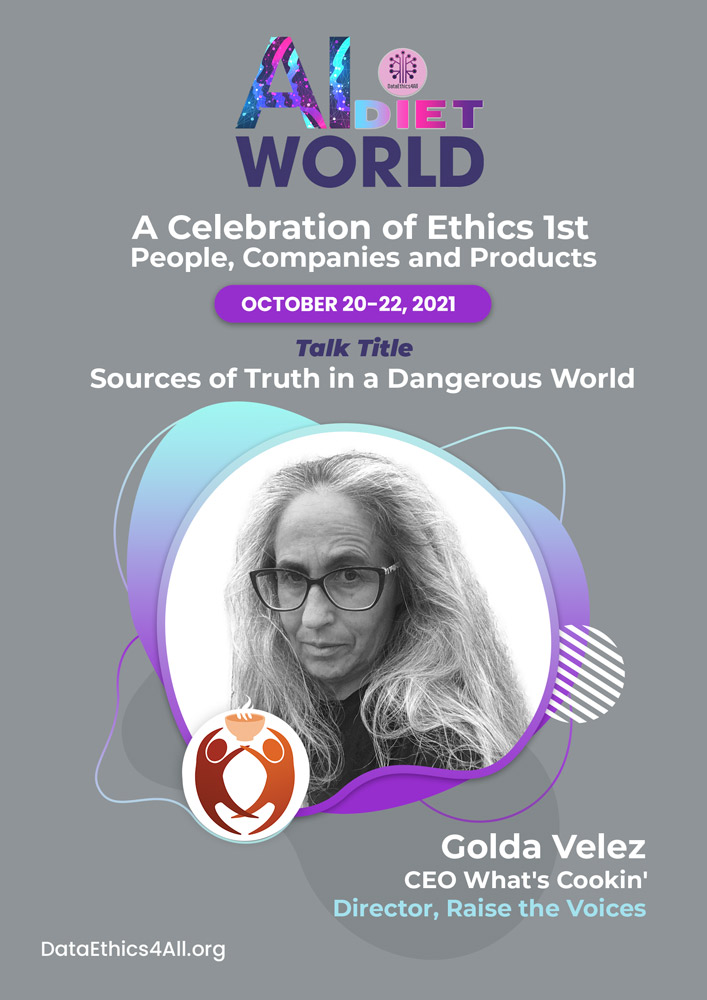
Golda Velez is a Senior Software Engineer in Risk, Caltech graduate, and human rights advocate.
Expand
0:06
Up next. We have Golda Velez. Golda Velez is a senior software engineer in risk. Hello, my title is Senior Software Engineer dangerous Caltech graduate, and human rights advocate. And I know she’s so much more than that what she has, you know, briefly mentioned here I’ll invite her Hi hi. How are you? I love your very brief introduction. I know you’re so experienced and you’ve got so much work and you are a leader in your own day technology. And you have some very interesting talk today that you are going to share with us I’m really excited.
0:54
Thank you. So there’s going to be more bottom-up. It’s not going to be rigorous scientific because I didn’t have time to do a scientific experiment based on the proposals I have. But yeah, let’s jump into it. I will share my screen Sure. What sees if that works. Okay. If I have to run to my second monitor, I will do that. And see, okay, great. So I’m just going to go ahead and present this. And can you see all right yes, we can build up all the best.
1:35
Thank you so much. Alright, so I want you guys who are listening to be ready to take a little bit of a different mindset. I’m going to shift your framework just a little bit. Because a lot of times when we’re talking about ethics in our eyes, we’re really thinking of ourselves, and most of us are high-end executives or software engineers in US and European countries. We have a certain life that we live in certain pressures that are on us and certain considerations we have but I want you to think a little bit about being connected in this larger world. We’re actually a very large number of people in the world that is not their situation. They may have similar skills, but they are actually in a world where they’re subjected to arbitrary violence. And that’s true in many places in the Middle East. It’s true in places in China. It’s true in places in Russia, is true in places in Africa, and South America. And in some cases, in some of the countries that we think of as the developed world. There are actually some instances of this, but mainly I’m talking about places where everybody knows that you can get hurt if you are caught saying the wrong things and there’s a lot of those places in the world. We are all connected. So the other shift I’m asking you to take is from Oh, I’m reading the news. Oh boy, that happened over there that has nothing to do with me but has to do with me. You know, I work at Uber, one of our board members happens to be a fellow who happens to be a Saudi guy who happens to be connected to people who he could have a very strong influence on some of the things in the Middle East if he wants to. And I am taking that money. So I am connected to that. I think a lot of us are more connected than we like to think about that how does this relates to AI? And this is why I said sources of truth. So if you want to take AI and try to solve ethical problems, what are the ethical problems we want to solve? How do you make models? How do you make you know we use the sources of truth to train those models is everyone who does AI you know that the source of truth means that’s the thing your model is trying to produce. You have a training set. Where do we get that training set for this kind of serious problem? And just kind of looking at the bigger picture of the problem. What problem am I talking about? I’m talking about the problem that disinformation, defends violent acts. I’m going to make the hypothesis as a hypothesis that entities that commit violent acts, not through a justice system, but just arbitrarily also tend to lie about them. And they tend to smear the victims of those acts. They tend to create a story that defends their acts, which may be provably not true. And they then promote that story on social media, and they have a lot of financial resources to cause that story to be promoted. So that’s what I’m talking about combating is the use of entities that have large amounts of financial resources to defend their violent acts by disinformation campaigns. So I feel that AI can be used for that. Now, some of you have, you know, when you think of AI use in social networking. You might think of things like Facebook, where we flag hate speech. We’re flagging those things and sometimes it’s individual hate speech, but often it’s actually troll farms and coordinated campaigns. And of course, there’s a consideration for free speech. You can’t just tell people they can’t say mean things because they can say mean things. But you have these kinds of things that have happened that were in some cases demonstratively. Supported by financed heavily financed disinformation campaigns. You can measure coordinated, inauthentic behavior, that’s something that’s that can be analyzed. You have all these different sites. This is a particular one, which was in the Middle East. But you know, it’s demonstratively a cluster of coordinated really posted releases about a particular subject. So this can be measured in those posts can be taken down. So a lot of places or Twitter or Facebook, do have algorithmic methods of finding a coordinated inauthentic behavior, but because it’s just an algorithm, they tend to be careful when you penalize it whenever you’re trying to set up a fraud response or risk response. You have to be careful with false positives. So you have to prioritize we’re going to penalize you can’t just strongly penalize everything that looks like inauthentic behavior, because at some point, you’re going to catch real users. Who is just going to tell their friends things?
6:20
So you have to kind of be able to prioritize those and that’s what we’re going to get into. Also, I want to emphasize that I’ve spoken to people who work at Twitter and work at Facebook in these areas, and they have told me that without humans, without the human operators of finding those sources of truth, they would fall down in a couple of days and just be overrun by spam. So we’re still really dependent on human judgment, for the source of truth for many things, the coordinated, coordinated campaigns can be detected algorithmically, but we’re really dependent on human judgment to create the source of truth for the models to ban the disinformation. Now, those human operators are low-paid people who may be in the Philippines who are scanning through all these violent images using some heuristics. And, you know, that’s what we have. That’s our defense is there but there are other things okay. So that’s, that’s what I was also going to talk about here is that, you know, we have all these kinds of human operators quickly scanning through works pretty well against spam because the incentives to spam are financial, and so you can kind of combat them either in a blockchain kind of way or just pretty simple, but if the incentive for the disinformation is outside the network, and it’s not just financial, it’s a dictator who’s in control of a lot of money, doesn’t want to have something exposed that he did, and he’s going to use all his resources to prevent it from being exposed. There’s just kind of overwhelming financial resources being set on the disinformation side of the equation. And then we have you know, these people trying to find it based on some criteria. They’re scanning through all this violent and explicit sort of stuff, and they have to be clicking on it all the time. So that’s one method that’s being used right now. There’s something else that’s happening that I think is not being tapped into. And what that is, is that there are already organizations that are what I call the high lift, but they depend on their credibility. The value of these organizations relies on their credibility. They are very careful before they accept cases. I know this because I’ve spoken to family members of Italians kidnapped, and I asked the Committee to Protect Journalists, will you add him to your cases and they’re like, Well, you can’t add him unless you translate everything he ever wrote. And we make sure he’s not a terrorist. So they really spend a very, very high lift before they will assert this guy was kidnapped, extra-judicially, you know, and injustice that he was kidnapped by his government. They, they really have a high lift before they take on that case. So there’s this high effort being done. You know, Bedouin camp has these volunteers that are really spending more time than the other human operators being hired by Twitter and Facebook carefully, logically analyzing photos. You know, in places like the New York Times and Washington Post these people spend a tremendous amount of effort. And we are not capturing that effort into the sources of truth except sometimes through the human operators who might look it up on these sites. But isn’t there an automated way that we could capture this stream of high lift high effort, kind of anchored assertions that we could then use to prioritize our models and interactions of our models? So that’s really my question. Can we if we set a clear goal, and more clear goals, we want to reduce disinformation that leads to violence. We have to have a way of measuring that or that’s associated with violence. And can we use these highly credible sources to maybe increase the penalties? So we’re not just saying oh, here’s some coordinated actions that happened, but it was all just to sell potato chips. So here’s a coordinated action that happened to smear the wife of a murdered person, and let’s prioritize that one. And on that one, let’s have a higher penalty that we can do to those devices in those accounts because they not only undertook a coordinated action they undertook the harmful coordinated action. And so you’re willing to set a lower bar or a higher bar as you will a higher penalty to lower bar for the penalty because they were so harmful, we’re willing to risk for false positives to eliminate this network that was extremely harmful, as opposed to the one that was trying to sell potato chips if you might let it sneak through.
10:50
So how do we do it? Um, I’m an engineer, but I’m not saying this is a finalized thing. I just wanted to put something out there. So it can be iterated on. You have to have some kind of machine-parsable format you have to have signing and credibility sticking because you can be guaranteed that the bad actors will attempt to put assertions into your chain of assertions, they will try to influence it. So you have to have credibility, staking by whoever is allowed to include reputation assertions, and you have to be able to either have a trust where we assign credibility for good reasons. Or have a way for people to lose credibility, because you have to really keep that a clean schema and it could propagate from those trusted organizations like CPGA, like Bellingcat that are already doing the highest level. I’m going to say I trust them, and I trust what they say. And we even pay them for it. And we have to be able to talk about entities. So there’s a couple of challenges here. But I think that we could do some of it quite simply. So here’s like a simple format. You have some subject that we’re talking about here, some assertions will have some qualifiers, and here’s who said it. And I would like you in the real world, we recognize the difference between me saying, I saw this with my own eyes. I was there I saw a policeman grab her by her hair and pull her down. I can say, I spoke to the sister of someone who was kidnapped, and she says he’s gone and she says that she can’t reach him. So I spoke to her. I might speak to someone whose name I cannot reveal because they would be endangered that I can assert I can stake my credibility that I spoke to them. Sometimes there’s been a thorough investigation. Sometimes you read an article and you’re simply sourcing from an article it’s on is it just your opinion? And I think we need to distinguish between those things, and create some kind of UX that allows people to easily make these rich assertions and not just click like thumbs up, thumbs down. It’s kind of like that reporting interface that we get. But I think that these things are so valuable in the real world and yet, we have no UX to capture these richer assertions. It strikes me that there must be some low-hanging fruit left on the table here that has a spot on the table with the thinking that there’s something that we’re not using in our models because this is what happens in the real world. We investigate things. So here are some sample assertions are position CPJ. And you might just be using a string, you might be better if it was an entity, but a string is somewhat useful because the strings are what you’re going to find on social media. You’re not always going to find social media referring to the entity, we’re just going to use the string. So here’s the verb. Here’s how we know about it. And here’s who. And then here’s one, there’s two of them. So CPJ did do an investigation says he was kidnapped. I also talked to someone who said he was kidnapped to know Him who would talk to people who do so I have secondhand information they have and so so you can then roll these up and give different levels of credibility. Now, how we’re going to how does this relate to the automated bot networks? One thing that happens quite frequently is you can use negative sentiment analysis to see when an automated bot network is creating negative sentiment towards someone who was actually initially so there was a smear campaign against Jamal Khashoggi visit, he was a terrorist and he was a terrorist, you should bring him to trial not kill him in some, you know, hidden way. So if there’s an audit if there’s a smear campaign against someone who was also harmed and in an extrajudicial manner, I think it is legitimate to backpropagate and say whoever is coordinating a smear campaign against someone who was imprisoned without a trial. That’s a problem and we should be able to eliminate that without being so afraid of the freedom of speech because it’s associated with harm. It’s not just that we’re saying go this guy’s saying dumb things is that we’re saying bad things about him and also we could not that’s a different thing. So you could use something like a box that you can find coordinated disinformation, your sentiment analysis, and then and then associated with those assertions, so it’s a little bit of a heavy lift, but I think it’s quite doable. I think it’s important to note that it should be done. There will also be other uses of reputation fees. This is a proposal I made in the Twitter blue sky project. It’s actually in a different order. So don’t get confused. Here. The user ideas first, and these are more granular assertions. Maybe here’s a journalist who says this photo I took it here’s some other guy who also says he took that photo. How do we know which ones which this guy says that I did? But maybe, if we trust Bellingcat, and Bellingcat says that this photo was adopted.
15:35
I’m sorry, he said he took a different photo, that if we trust Bellingcat, we could propagate the trust and then have low credibility for this guy who’s associated with a photo that built-in Kazakh was doctored. So these things would be higher lift. I know they may be higher and harder to scale, but I think there if we allow a UX with somewhat rich assertions, we get a lot of data. Because there are people who have a stake in asserting those things. And for example, the Bellingcat volunteers do a lot of granular assertions all the time, but it just comes out as human-readable text. And if we could get that into machine-readable assertions, I think that’s just a really valuable data source that’s being accommodated. So really, what I want to say is that you may not have the full solution, but we have to be working on the right problem. And I know privacy is important. I know other things are important, but you know, she’s dead. He is up for 20 years. He was on Twitter. He had a blog on Twitter with a lot of followers. And they hired someone at Twitter to find his IP address in his location and dragged him away things of the Ramadasa done. This is terrific. He spoke up for his friend who had been kidnapped and the next day he was kidnapped and that was a little over a year ago. He’s still gone. He’s in Iraq. And actually, this elimination forgot her name, but she’s in Russia. She is a journalist who was also killed. So we’re not really making a systematic effort to stop this. There are news articles and everybody goes on with your day. But we’re not going to a system of experimentation and outcome measurement to stop this from happening, and I think we should. So thank you very much for listening. I would love to take some questions. I have a lot of anecdotal burns I could share with you just to chat a little, Golda, great talk. I know we have some great comments here. So what data let me show this what data do you input in your first training model?
17:40
Right. So I think that we have to first allow for these granular assumptions, assertions to be made. And then I think you have to allow for entities from trusted to decide on an initial class that you decide maybe there is and that’s a really good question. I see someone saying how do you measure trust that you have to initially, you know, have people talk about it. I think that that having the initial conversation of who’s trusted is an important conversation to have. And I think that there should be a consensus about these organizations which are trusted by our government. You know, by the United States government. They’re trusted by the United Nations, the Committee to Protect Journalists, Human Rights Watch. There is no disagreement on that universe, always a political consideration. But I think that there certainly Snopes, you can name maybe eight or 10 organizations that are high trust and assign certain initial customers, that’s fine. And then you can include things like Sarah who has a human jury on is this human. And if you allow a lot of granular assertions and think that you are going to get things that are provably wrong, a person will assert that they are human when they’re not, a person will assert that they’re in the United States, not in the United States. And some of those things could be tested in a granular way and you can backpropagate the errors. So, I don’t think that I have the entire model completely sketched out, but I think we need a rich data source. And we need to recognize that there’s credibility staking, we can have initial portability and there has to be a way to adjust that and that we need to start those models.
19:21
And I also like your thought on credibility is taking from the number of degrees apart, right? If it’s the first person who has direct experience, versus a third person third-degree apart was just read it in news versus second person, like, you got the news from the sister who was kidnapped, right. So I mean, it would be hard to put those kinds of I mean, it makes sense and I can see some challenges and how if he created a public network like that, how we would put weights and parameters on those weights.
19:58
The assertion is that I say that I heard the second you know, someone says there was an investigation, so that started what data and then you can have different models that put different weights and you can start testing them with their outcomes, but you have to have the rich data for them to model alright. And that brings us to the point that people are honest and when they are saying that this is what I heard from someone nowadays, people share information as if they have first-hand information on it as if they are the authority on it. So it’s very hard to understand if this is hearsay or if it is this is coming first and I want to think
20:42
We can actually, I mean, we could have a view that depends on my point of view, I could say I trust TPJ and anything that they you know, say I want to be propagated strongly to me. Um, so I could say in anybody that they trust, I also trust and you could have fast web. So then the people who are kind of tools are not really going to be kept in that test. They’re going to be in their own bubble and those that trust each other. So I think you can address it
21:07
Might be easier for organizations than for individuals. I feel like organizations over time can be trustworthy and we can give them extra ways that they are trustworthy. For individuals. It might be a little harder to implement, but certainly, something to consider. And I think they’re just so many questions. I think God has another question when we talk about long-term democracy, democracy infrastructure, in fact, scientific evidence, and the dissemination of such must be funded. It cannot be a ragtag group of volunteers. If we aspire towards democracy, we must make long-term infrastructure investments.
21:46
Yeah. I mean, I would definitely agree with that. I think we’re getting somewhere. We’re getting somewhere with the dowel model of voting on using funds. I think that’s positive. I think that there needs to be a little bit more delegation and a little bit more conversations in the down models, but I think that they’re a good start to having democratic control over funds that maybe could be directed towards that. I would definitely like to see governmental support. Of those. You have to be careful with organizations because they can be bodies of longer than people but they can be taken over to make sure the organizations themselves have an infrastructure that’s not easy to simply take over by somebody purchasing the organization or buying a new board seat.
22:31
Lakisha says always showing my face.
22:36
Absolutely. I mean, sometimes it has to stop with a second-hand reporter because I can’t say who told me, but I’m willing to stake my credibility. on it and lower my credibility.
22:49
When he says however if the information is coming from reliable sources and then corrected based on what we knew then versus what we know now, then they lose credibility.
23:03
If I’m asserting that somebody was murdered then they are alive, I think I should lose credibility because I was wrong. You know, it depends on what you’re observing. You should be careful to assert only things that you actually know or that you’ve investigated.
23:19
Darren says I bought us a US historical model to predict the probability of trusted information data not perfect but based upon prior experience with souls.
23:31
Yeah, and I think that if you use them over time you build up more of that historical data that you could use in a machine possible way. Initially, human experience because we don’t have it.
23:42
So I know that goal, you said that this is not a fleshed-out model. This is something that you are thinking about and doing and I would love to get you more involved. We have an active community and we always know you work with blue Stein, you work with a lot of other organizations as well. I would love to continue the conversation and see how we can actually build something.
24:04
To do it, I’d be happy to advise people to make suggestions and mentor and bring them, developers. And I want to just mention really quickly, I’ve one minute left. Making direct contact with people is so valuable. And there are developers in Myanmar. There are developers in Afghanistan, that we’ve actually been hired as women in Afghanistan. I have the CDs of about 20 or 30 women in Afghanistan right now who need remote work for attorneys and civil rights workers who could maybe do some of this work, and they don’t need a lot of money, but they need jobs quite badly. So if there’s any funding of $1,000, you can actually hire 10 people and transform the life of 10 women in Afghanistan right now. And I’m in touch with America, the slack group. And there’s just so much that you can do when you get in direct touch with people and sure I would love to participate.
24:49
Yes, absolutely. I’ll be in touch. We would love to be data ethics. We’re all would love to be a part of something like this and bring up a project that helps and makes an impact globally. So I’ll see you later. Thank you. Take care. Bye!

DataEthics4All hosted AI DIET World, a Premiere B2B Event to Celebrate Ethics 1st minded People, Companies and Products on October 20-22, 2021 where DIET stands for Data and Diversity, Inclusion and Impact, Ethics and Equity, Teams and Technology.
AI DIET World was a 3 Day Celebration: Champions Day, Career Fair and Solutions Hack.
AI DIET World 2021 also featured Senior Leaders from Salesforce, Google, CannonDesign and Data Science Central among others.
For Media Inquires, Please email us [email protected]
Come, Let’s Build a Better AI World Together!
Share:
Written by:
Tags:
``There's no future that doesn't have ambient computing or voice activation. None`` - Dr. Joan Palmiter Bajorek
“When we think about the future, we’re still building what that looks like and how we move forward.”
– Dr. Joan Palmiter Bajorek
I am text block. Click edit button to change this text. Lorem ipsum dolor sit amet, consectetur adipiscing elit. Ut elit tellus, luctus nec ullamcorper mattis, pulvinar dapibus leo.
I am text block. Click edit button to change this text. Lorem ipsum dolor sit amet, consectetur adipiscing elit. Ut elit tellus, luctus nec ullamcorper mattis, pulvinar dapibus leo.
“Our mission as a 501C3 is to amplify, empower, connect, celebrate women and diverse people in the voice tech field”
– Dr. Joan Palmiter Bajorek
Expand
What are voice and conversational AI? Are there jobs in this sector? How do you find and land them? This talk covers the booming voice and conversational AI field (think Siri, Alexa, Google Assistant, Apple Watch). Famed investor, Mark Cuban, recently stated, “There’s no future that doesn’t have ambient computing or voice activation. None.” Tech giants such as Alibaba, Amazon, Apple, Facebook, Google, and Microsoft are investing heavily in voice technology in competing in both hardware and software. In 2017, Amazon had 5,000 employees working on the Alexa team and by 2019 that number had doubled to 10,000 employees.
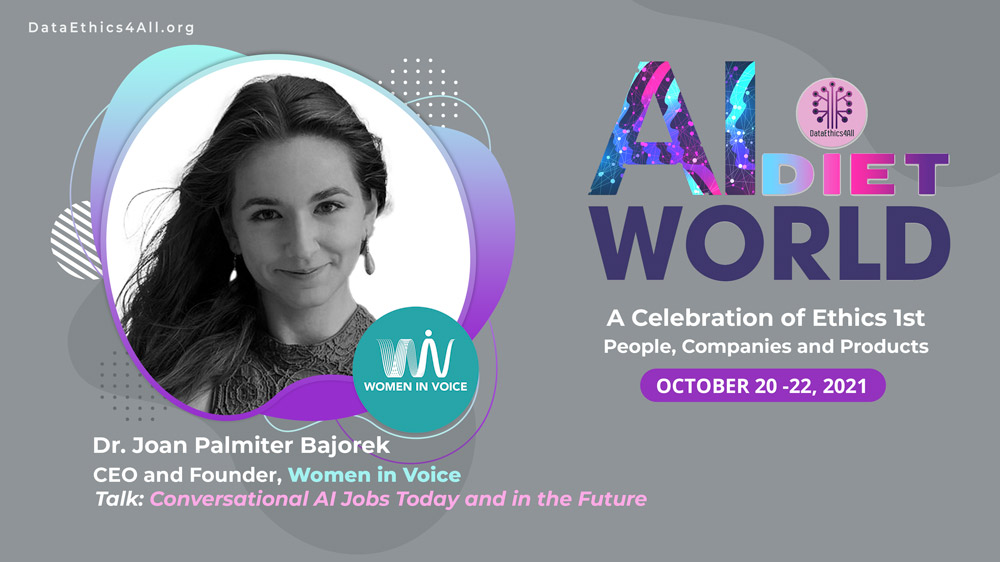
Dr. Joan Palmiter Bajorek is the CEO and Founder of Women in Voice (WiV), the international nonprofit empowering women and gender in voice tech. In 3 years, WiV has scaled to 21 chapters in 15 countries with over 100 international ambassadors and is an official 501c3 Nonprofit. Partnering with Google and Amazon at events around the world, WiV is helping to shape the voice tech field to be more welcoming, inclusive, and intentional as it grows and flourishes.
Expand
0:00
Next, we have another amazing speaker and storyteller and another nonprofit woman leader women in voice, sharing her journey her story on what she has done, how she did it, and why she started Women in Voice. Let me introduce Dr. Joan Palmiter Bajorek is the CEO and founder of Women invoice, the international nonprofit empowering women and gender invoice tech. In three years, women and voice have scaled to 21 chapters in 15 countries with over 100 International ambassadors. And as an official 501 C3 nonprofit partnering with Google and Amazon at events around the world, women, and voice is helping to shape the wise tech field to be more welcoming, inclusive, and intentional as it grows and flourishes. Please welcome Dr. JOANNE Hello. How are you? Well, how are you? I’m doing well. Sorry to keep you waiting. I know you’ve been waiting for a long time. But yeah, that’s how live events are. You’re doing okay on time. Not too behind. So I’ll let you take the stage. Thank you
1:24
For when it’s so grateful to. It’s wonderful to be here Linda and I, I’m going to try to share my screen, and looks like we’ve been having some, or let’s see how this works. There are two monitors. Okay, just a moment here. Give me just a second. Okay. And then if I Ctrl L, I believe, can I get confirmation that you can see my screen?
1:50
Yes, Linda, we can see your screen and your slides. Okay.
1:53
Awesome. Thank you. Well, it’s wonderful to speak with everybody today. I’m very excited after these other talks, to really delve deeper into the voice field, and conversational AI. And This talk is a dovetailed kind of conversational AI and jobs. So conversational AI jobs today. And in the future, you just heard my intro. So that’s a great place to start. I’ll also just say that I’m a C. Hi, my name is Joan. I’m based here in Seattle. I really have a two-pronged career that’s going on that you’ll certainly hear about today. And this work is presented. I have a Ph.D., I do research in the voice and conversational AI space. I have multiple publications that I’ll be thinking about briefly. But also really, the more I delved into conversational AI, natural language processing, kind of the future of what these tools look like. Also, really importantly, the social impact of this work and the importance of having lots of different people at the table. And so three years ago, I started Women in Voice which is now a global nonprofit and a 501 C three, and been featured at CES and, and worked previously at nuance and Alexa champion amongst many other accolades that are great. But today, I really want to talk to you about three topics, voice and conversational AI, jobs in the sector of which it is proliferating really fast, if you are thinking about pivoting, really consider my field, please. And also a lot about women in voice and the community that we are growing here. So um, you know, some people don’t even know my field exists, but Mark Cuban does. There’s no future that doesn’t have ambient computing or voice activation. None. So when we think about the future, we’re still building what that looks like and how we move forward. But even big, big investors see our space as really a fruitful place to be. So when I talk about voice, what does that actually mean? Is this a field? Hopefully, you have heard or seen, or even use it daily, Siri, okay, Google, Alexa devices are proliferating in the space. And we certainly see this as a hardware play, but also as the software evolves. And hopefully, if you have an iPhone, for example, it seems Syria evolved dramatically in each deployment iteration. So this is what I’m talking about for an end customer experience. But when we really think about conversational AI, we’re often thinking about a voice experience where the input is spoken language, we have some hardware and computing on the back end, that’s cloud, usually, and then the output being spoken language. But this is a really simplified example of what we’re seeing in the ecosystem that both Linda and the speaker before we’re talking about these integrated systems, where we’re seeing inputs that can be speech, they can be biometrics, that can be plenty of different things. The hardware can be you know, VR, there are so many different ways for hardware as well. Like, gestures, etc. Our computing power is getting more and more sophisticated. And what we’re doing on the back end with machine learning, as we saw that cool video and the tech stacks are getting really sophisticated, our outputs could be your cons, they can be switching on and off the lights, we’re really seeing voice and conversationally I expand into many, many domains. So across the stack, a lot of sophisticated things are going on. And when I think also about the kind of trajectory of my fear and kind of think about multimodal, if you give me this little rabbit hole more, my field frequently talks about the term multimodal and leveraging different modalities like I was talking about. So leveraging text, how’s that integrates with touch, audio, computer vision, AR VR gesture voice? In medical contexts, how gesture might be the right approach to not touching things, especially during COVID. We were more sensitive to what we touch, augmented reality, and E-commerce spaces, you know, does this sofa fit well in this context, and really be able to ask and talk to different devices, like Google Assistant in being placed into different IoT. So we call we often call this multimodal the jargon doesn’t quite matter, the concept does. And so I have even more examples of people all around the world using this technology. In different languages, especially potentially, you saw the Ray-Ban and Facebook announcement recently, it’s kinda AR classes that are being built out in that space, as well. But really, I think when we talk about kind of ethics and how it’s being used, there are some really cool applications. My friend in Nigeria is working on kind of how we look at biometrics, and computer imaging, that matches with kind of semantics or kind of pairing like this motion would be explaining, right in the future, we’re tying those things are currently, there’s a really cool company called Affectiva, that was recently acquired by an automotive company looking at lots of different biometrics. And looking at kind of this is one example of a patent they have drivers and using facial and vocal expressions to identify if the driver might be drowsy or intoxicated. And unfortunately, in the United States, 25% of all US traffic-related deaths are related to alcohol impairment. So it’s really the translation of here’s this dataset. Here’s how we’re interpreting this dataset. And what are the kind of ethical or direct
7:34
Legislation potentially even that can be put in place related to these datasets. So it’s really interesting the implications and the importance, but also how we leverage this data as it evolves, and how we can process it. So I have even more slides specifically about natural language processing, which I think a lot of people throw around the term NLP, but you use it, almost everyone is using this more and more. Here’s an example of bill pay. Many of us are our texts are blowing up with bots, and automated material. But on a fundamental level, natural language processing is organizing human language in a sophisticated data-driven computational way. I think we would love to run jargon, but the concept is very concrete. So what that looks like as far as conversational AI, if you use Google Assistant, one of many different systems that were tagging entities, and that your bot, you know, book a flight from Los Angeles to Hawaii, for less than $300. And the system response, you got it, what we’re doing on the back end, to geotag, to look at currencies. This is just a textual-based example. But all the different slots that are going on in these systems behind the scenes. So from that, from the big abstract picture to the more concrete example here, of what conversational AI is doing. So the more I looked into this, the more excited and concerned I was, this is my publication called Voice Recognition still has significant race and gender biases. When we look at the datasets being used, when we look at how this data is being leveraged, and the kind of implications to immigration hiring practices, which were mentioned earlier today. You know, there’s some there are some really problematic and troubling things. Specifically, my research looks at kind of the implications of breakdowns when we see discrepancies, the dramatic changes this makes to people’s experiences. So, you know, a lot of people don’t necessarily want to look at big datasets or, or research this way, but really breaking it down to you know, if Josh White male gets like an A-minus the discrepancies in me reading essentially the same paragraph in a voice AI system as a white female, that I might it might interpret as a c plus of how well it interprets my voice, and for a mixed-race female even worse than that. At a deep plus. So these seemingly small biases and breakdowns and with massive, massive repercussions. And so as I mentioned that these questions, I’ll go back really quickly these questions of race and gender biases and try to understand do I really think that people are, I fundamentally don’t believe that people are trying to make biassed systems. In fact, people have a lot, a lot of incentives to make these systems as good as possible, financially and otherwise. So I really saw an opportunity for us to amplify the work of women. And I think a lot about women who are already killing it in our fields, but also kind of our pipelines, as well as retention of talent. It’s really mostly a retention problem, but most people don’t even know about our field. So we’ll start there. I came up with the idea of women a voice, I’ve launched a call for leadership, a bunch of people signed up, there was a lot of interest right away. And we have scaled really fast since we’re in almost every continent now. Launching in Africa soon, I hope, that really partnering with different organs that share our mission, and see what women a voice can become and how we are working to shape our ecosystem. So our mission as a 501 C three is to amplify Empower, connect, celebrate women and diverse people in the voice tech field via community networking, education events, etc. What I usually say is, you know, our tagline, where the woman who codes for voice tech, if you think about us that way. So we specialize in our vertical in our domain.
11:41
Yes, so as mentioned, we’re all around the world. We’re international by design. In three years, we’ve hosted at least 150 events, come check them out. They’re all online these days, and most of them are free and open to the public. I think there’s just one thing to talk about the numbers. And then it’s another thing to see the faces of ambassadors and events going on all around the world, most of these prepaid Dimmick. But just to really the community, not feeling alone feelings of belonging, and how we support each other is extremely important to retention and opportunities in our field. So, as mentioned, this field is evolving fast, there are so many different pieces and components to it, that it’s hard to imagine one wouldn’t be inspired or interested in participating in some ways. If you’re interested in jobs in this field, my colleague Yara Martino has written up kind of job titles of what’s going on in our field. And kind of the proliferation of what this looks like. So check out jobs titles in conversational AI Addison medium posts, you can also listen to them. But just I’m going to read out the number of jobs in this space on the design and writing side on the AI NLP, machine learning data science side speech scientists, voice actors, researchers, people are hiring like crazy for these jobs. And we’re seeing so many companies hire for Director roles, which typically are hiring for a headcount of four to 10 so there are so many jobs, and we just launched the jobs were in fact, and WWW dot women invoice jobs.org comm check it out so many cool jobs all around the world. And I would be remiss not to mention that women voice we are building out tonnes of programming and events for people to participate in and ways for people to join different initiatives we have so right now I’m running a career accelerator for people to really advance their career and work on that in a dedicated way. We have a membership that has tonnes of really cool perks, freemium to 100 bucks model, comm becomes a member pitch events really supporting female founders and connecting them with investors in our space, as mentioned with Mark Cuban and so forth. That’s sponsored by Amazon Alexa startups. We have two more coming up this year. So you can find all this and more and women invoice.org. And we have a gala. In December, I’m really, really excited about all virtual fear not but really a celebration of the work we’ve done, especially this year, as well as a fundraiser code. So come check that out women voice.org/gala. And our influence, reach and engagement cannot be underestimated. Just people all around the world are finding us across social media platforms come to check us out and whichever ones you participate in, but we are reaching people in Croatia, Nigeria, like the spread of what we’re seeing of people being really interested in our space and coming to join us is extremely exciting. So we’re still early days as far as I’m concerned. Women in voice let’s shape the future of voice together. Thank you so much for listening to this talk and I look forward to connecting with you again. Please learn more at women invoice.org. And if you’re sitting sponsorships admin wouldn’t invoice at work as well. Is there So thank you so much for having me.
15:02
Thank you, Joel. This was awesome. Yes, definitely we need representation in voice tech. So this is awesome that you started this movement. And from the numbers, it seems like you’ve done a fabulous job so far, and it’s only going to continue and grow. And I see that even though it says women and boys, but also it’s open probably to everyone, right?
15:29
Absolutely. I mean, we are so interesting. As we look at our numbers, we designed for kind of women, and gender minorities in our space, or materials consumed by like a 6040 split. People were tagged as women and men like we especially we want to have allies in the room. Our content, people are paying me like, Can I join where can I sign up? How do I participate? So certainly, we’d love allies, and we’d love that narrative of everyone together, building and learning and growing. So we certainly foster that.
15:58
Yeah, yeah, absolutely. All right. Thank you, John. Thank you

DataEthics4All hosted AI DIET World, a Premiere B2B Event to Celebrate Ethics 1st minded People, Companies and Products on October 20-22, 2021 where DIET stands for Data and Diversity, Inclusion and Impact, Ethics and Equity, Teams and Technology.
AI DIET World was a 3 Day Celebration: Champions Day, Career Fair and Solutions Hack.
AI DIET World 2021 also featured Senior Leaders from Salesforce, Google, CannonDesign and Data Science Central among others.
For Media Inquires, Please email us [email protected]
Come, Let’s Build a Better AI World Together!

Share:
Written by:
Tags:
``We disrupt stereotypes, we show that there's no group that has a lock on being smart, successful`` - Linda Calhoun
“Our mission at career girls has founded on the dream that every girl around the world has access to diverse and accomplished women role models, to learn from their experiences”
– Linda Calhoun
I am text block. Click edit button to change this text. Lorem ipsum dolor sit amet, consectetur adipiscing elit. Ut elit tellus, luctus nec ullamcorper mattis, pulvinar dapibus leo.
“I wanted girls coming up behind me, especially girls from under-resourced areas, to know that you could have complete agency over your life”
– Linda Calhoun
Expand
The talk will focus on Career Girls’ work to interview dozens of diverse women experts in data science, artificial intelligence, machine learning, and robotics to inspire youth, especially girls, to learn about the critical issues and career paths surrounding these topics. These subject matter experts have directly engaged with girls in two virtual camps focused on the work they do in AI, ML, and Robotics. I will also share the impact metrics of our virtual programs for girls. Linda Calhoun is an entrepreneur, activist, and community leader based in San Francisco, California. A graduate of Boston University with a B.S. in Mass Communication, Linda’s career path led her to work in international policy coordination, media, technology, and data management. Linda is the Founder and CEO of Career Girls, a nonprofit that was created as a response to the inequality of opportunity that Linda encountered in her story. She is the President of the Career Girls board and additionally Alliance for Girls and Friends of the Commission on the Status of Women.
Expand
0:01
So Linda Calhoun is an entrepreneur, activist, and community leader based in San Francisco, California, a graduate of Boston University with a BA, BS, and mass communication. Linda’s career path led her to work in international policy coordination, mi EDR, technology, and data management. Linda is the founder and CEO of career goals are nonprofit that were created Linda encountered in her own story. She is the president of the career girls, board, career girls board, and additionally alliance for girls and friends of the Commission on the Status of Women. Please well, come. Linda Calle Hahn. Hi, Linda. Oh, my God.
0:58
Thank you. I feel like I’m on stage now. Um, can you see my slides? Or should I share my screen? How would you like me too, to handle my talk at this point?
1:17
Five, please add your slides.
1:20
My slides are up. Awesome. So first slide. And one thing I’d like to make abundantly clear is I am not an expert in AI. But I had the pleasure and the privilege of interviewing 25.
1:43
Sorry, Linda, do you have your slides?
1:47
I can share.
1:49
Yeah. Do you want to share your slides? Yes,
1:52
yes, yes. See, if it comes up.
1:59
I know you’re going to add the video to it. And then you’re going to share that. So
2:04
hold on, I think.
2:07
Okay, there you are. Okay,
2:09
so let’s see if we can get the slides going.
2:13
Ah, see this go to press present mode?
2:16
Yes. Here we go.
2:23
There you go. I’m going to go backstage and let you continue.
2:28
I’ll take it from here. Thank you so much. As I was saying, I am not an AI expert. But I’ve had the extreme pleasure and privilege of interviewing dozens of very diverse and accomplished women who are working in artificial intelligence, machine learning, and robotics. So you should consider me someone who’s worked with your current colleagues, to hopefully grow a pipeline for future colleagues. And so I thought it would be fun to start with this throwback Thursday photo. So here I am in second grade. And I think what’s important to know about me at that time is, you know, I am the first in my family to graduate from college. My parents were the first in their family to graduate from high school. And all four of my grandparents never went beyond the eighth grade. So my family knew the power of education, and that it was a way to have a better life. And I’m also not ashamed to say that encyclopedias were my best friends growing up. And those books really fed my imagination. And I loved learning and experiencing the power that comes from knowledge. So, you know, here I am, closer in age to college. And this is where a lot of my critical work and preparing for college came from, you know, I studied hard, everyone in my family was like, you know, you are college material, you can go to college, but I knew there was no money to send me and that I’d have to earn an academic scholarship, you know, so I did the things that were necessary at that time to be able to compete for a scholarship, you know, I took AP classes, Honours level classes. You know, I watched my class rank, because I knew I had to be at a certain grade point average in order to be seriously considered by the universities that I was interested in. And I really challenged myself to and made sacrifices to achieve my goals and you know, just try and broaden my experience outside of the very small town that I was living in at the time, you know, PBS documentaries, newspapers. And I also remember the library being a refuge for me this, this bastion of where you can discover and learn. And I think second only to getting my driver’s license, having my library card was my most prized possession. So here I am, you know, on my graduation day I did it, that milestone was accomplished. But then what and, you know, I had so many examples of very hardworking women who, you know, were conscientious and, but they didn’t have careers, like what I inspired to do. And so it took me a very long time, from when this photo was taken to where I was really able to hit upon work that was fulfilling in every way. And it just so happened that it happened to be in database design. These are in the early days of building geographic information systems, relational databases, I was doing it on an international development project. And it was just extraordinary, you know, rewarding financially, economically, intellectually. And I wanted girls coming up behind me, especially girls from under-resourced areas, to know that you could have complete agency over your life, based on what you’re passionate about how your mind works, coupled with educational attainment. So that was really my aha moment.
6:50
So now you know how the idea for career girls was born. And I was just absolutely determined to give back to girls. And as they said, Girls who could really relate to the circumstances that I grew up under, and I just started reaching out to very successful and accomplished and diverse women. And just ask them to share, you know, what it, what it is that they do, how they got there, but most importantly, what girls can do in order to create a life and a career of their dreams. And this is how it’s happened. This is how I was able to start my nonprofit. And one of the things that I love is this is just a tiny sample of the 800 women that I’ve interviewed since the site went live in January 2011 Is that we disrupt stereotypes, we show that there’s no group that has a lock on being smart, successful, any adjective you want to use, you know, this collage speaks to the diversity of the women that we’ve been able to interview. And it’s just wonderful to be able to have girls anywhere, come to our site, and be able to navigate to someone whose story would resonate with them. So we are a free career exploration and readiness video platform. And not only do we provide the video inspiration, but the see-it part of you also can’t be it if you can’t see it. We also combine that with the how to be a part of the curriculum, with career readiness information with college readiness information to really provide one-stop shopping for girls who come to our site, and also stakeholders, parents, educators, mentors, who want to use our content to underscore their messaging. We just want girls to be able to come here and be able to create a career and a life of their dreams. So I wish I know, particularly in the STEM fields, you know, girls really don’t see themselves in these careers as much as boys and they tend to get left behind. So if you remember when I mentioned encyclopedias and how they fed my imagination, so did watching television, you know, getting the sources of ideas and stimulus. They’re really important for developing your imagination of what’s possible. And imagination lets you find the things that are important to you and honor your interest and, you know, help you show up who you are. And so, you know, we want girls to understand what are their dreams, what are their passions? What is it that excites them? And then not only is it you know, so that they can come in develop their own full, full potential but how are they going to make a difference in the world? How are they going to give back using this passion using their education, and all of these, you know, concepts are very important in terms of, you know, letting girls see what’s possible. You know, I simply wish I had known that you could have a career based on how your mind works, writing a scope of work, saying you would do it, what you would do it for, and people would pay you because I would have prepared myself a lot sooner. And so we want girls to understand, stay on track in math and science, which there’s parity in terms of how boys and girls do with their interest inaptitude for math and science, till about fourth grade when girls start to fall behind unless they can see women role models who are working in those fields. So we like to think of ourselves as sort of the bumper guards to help girls stay on track academically. And while we aim to serve a young age cohort of girls, ages 10 to 13. We also know from our analytics that 47% of our audience are young women, ages 13 to 14. So our solution, you know, our mission career girls has founded on the dream that every girl around the world has access to diverse and accomplished women role models, to learn from their experiences, but for those girls to discover their own path to empowerment, so we close the imagination gap.
11:44
And when you navigate to career girls.org over 600 role model pages, which translates into over 13,000 inspirational and informative videos, we have career prep information for 150 Plus careers, you can also take a personality-based career quiz. For those first-generation college students, we have over 100 college majors, and what you would need to study in order to earn a bachelor’s degree related to any of those careers. We also have information. We call them empowerment lessons, several role models speaking to a career-based exploration theme, or a soft skill required for social and emotional learning. And then we have a curriculum and toolkits to make it easy for those stakeholders. As I mentioned, educators, mentors, parents, to be able to use our content to augment or supplement any of their own programmings. So in 2020, and we all had to pivot and make do with the fact that there wasn’t direct engagement with students, we decided that we would do virtual programming. And the very first one we did was last summer, in 2020, which brought together so many of those women that I’ve been interviewing over the past two and a half years. Once I learned about JoyBell and weenies research on the deficiencies of facial recognition software, it just became a driving intentional act on my part that we’re ever we did a video she we was going to interview diverse and accomplished women who are going to speak to the important issues in an AI as well as the different career paths that you could have. And so this summer, we also did a repeat of that camp, where we had 75 Campers are 25 role models. These are all women experts, subject matter experts who were speaking to girls about artificial intelligence, machine learning, and robotics, as well as careers in those particular fields. And the feedback was astonishing that the first year that we had our virtual camp, we had a small core cohort of about 30 Girls, and 10 of those girls after the end of our week-long camp also agreed and wanted to participate in another three-day minicamp that was a deeper dive into artificial intelligence and machine learning. And our campers are incredibly diverse. As you can see, we had a large degree of Black and African American girls, Latina and Hispanic girls, Caucasian, Asian, indigenous First Nation so We just had an amazingly diverse group of girls who enjoyed seeing role models who are diverse and very much internalized a lot of the messaging and understanding of the issues that they can address in the future related to artificial intelligence, the bias issues, machine learning, where did those datasets come from, and for robotics, understanding who is programming a robot to do what, so it was a phenomenal experience. And now I’m going to play a short video for you that is the highlight of our camp.
15:45
Career girls are connecting role models and girls around the world through our virtual camps. These inspirational camps feature industry-leading role models and are offered free of charge to girls of all backgrounds. Career girls second virtual AI and robotics cam focus on how AI enhances the creative process of machine learning how robots see and react to the world ethics and AI and career exploration.
16:12
A lot of the things that we do in technology are based on creativity alone. No one would ever think that I’d be doing a zoom call over a mobile device. So someone had to really visualize this happening. How can AI be used to enhance dance, it could
16:28
like Teach you specific types of dance, or inspire
16:31
you to be more creative,
16:33
it can bring people together through dance
16:37
The video was that interesting to see how the movement of the people could be transformed into a computer, and that it would pick up on your key joints and stuff without weighing any special.
16:54
We’ve seen robots that could help us explore area that is dangerous or invisible for human beings. We have seen robots who can improve our productivity. And the robots that I personally like the most who can take care of our tedious housework,
17:09
I learned about a robot in my breakout room, it looks at the water, and like the deep sea with the Sona and camera. It also examines cruise ships to look for any damage or things that could be hazardous to the ship so that humans don’t have to go down there. It’s dangerous.
17:29
It’s all machine learning concepts based on neural networks. And lots and lots of this is going to be a game pretty much like the game of Pictionary, except the computer is going to guess. And they do this by using machine learning. I see a line or leg or hockey stick. Oh, I know it’s an umbrella,
17:48
He noticed that it was going through stages and picking out exactly what potentially it could be. But there was one trigger that made it specific to what she was drawing. And that is exactly how machine language works.
18:04
So that drop-down list is a dataset that is important because of the data that goes into those datasets that create the algorithms and create the models that you see. And so it’s really important that we have a diverse set of folks who are building those datasets that go into the results that you see to be
18:24
Involved in robotics. Is it important to have knowledge of both hardware and software? Or is it completely fine to specialize?
18:32
It’s completely fine if you specialize in one. And I think that if you weren’t about the one you usually end up learning about
18:39
Something I didn’t know when I was the campers ages that you can have many jobs and many careers. It’s not just one thing, and you are doing it forever. Or it’s not even just one thing in your day today.
18:52
What’s really exciting about being an AI, in general, is just really early so you have kind of this wide-open field of what you’re able to accomplish. In my breakout room, I learned that you have to keep going get your dream. Don’t give up. And even if
19:12
You don’t know what a robot is, or how to work your robot doesn’t mean you can’t work for the company of the robot. Thank you to all of our industry leaders and experts for volunteering their time to share their knowledge and insights with our campers. And thank you to the campers for joining us. We can’t wait to see your success in the future. Bye everyone
19:49
Thank you. I’m trying to stop sharing my screen is it gone away?
19:54
Yeah, I did. Yeah, exactly. Awesome. So I don’t think we have any questions for you but very inspirational messages coming from all over Linda. You are an inspiration, brilliant topic, love your vibrations. Love how you pivoted during the pandemic social awakening moment, all these kudos for you and your team, Linda’s career. Good,
20:25
Thank you. But I hope everyone understands that they’re watching their future colleagues, these girls are amazing. And it’s so inspiring to see how they want to take their perspectives, their knowledge, and expertise to make the world better for all of us.
20:44
Absolutely, yes, they are our future leaders. And I think you nailed it like we have to, for our free stem program also, that’s what we feel like, you know, it’s like, we have to honor these kids, and they just have, they’re not just an abundance of energy, they have so many great ideas, and they know they have a perspective on how things should be run, how things should be done. And we have teenagers and their friends and we have these discussions and you see this inspiring group of youth leaders today who have so many ideas to change the world. And so, yes, I’m very positive about what the future holds for us. Thanks again, Linda.
21:30
Thank you for having me.
21:32
Take care. Bye-bye.

DataEthics4All hosted AI DIET World, a Premiere B2B Event to Celebrate Ethics 1st minded People, Companies and Products on October 20-22, 2021 where DIET stands for Data and Diversity, Inclusion and Impact, Ethics and Equity, Teams and Technology.
AI DIET World was a 3 Day Celebration: Champions Day, Career Fair and Solutions Hack.
AI DIET World 2021 also featured Senior Leaders from Salesforce, Google, CannonDesign and Data Science Central among others.
For Media Inquires, Please email us [email protected]
Come, Let’s Build a Better AI World Together!

Share:
Written by:
Tags:
``AI is one of the most powerful tools developed in the last 15 years. But it can't magically solve problems.``
“I grew up in coastal California I had a lot of advantages actually made pretty clear to me early on. I was supposed to win the Nobel Prizes somehow, and also be a sports star.”
I am text block. Click edit button to change this text. Lorem ipsum dolor sit amet, consectetur adipiscing elit. Ut elit tellus, luctus nec ullamcorper mattis, pulvinar dapibus leo.
“I built it because I wanted to give someone a superpower. I want to give them the ability to read facial expressions, because it turns out they have autism. And one of the most common symptoms of autism is an inability to read patients.”
Expand
Ever-improving AI and stubbornly resistant systemic bias is quickly turning human capital into a toxic asset. Problem-solvers take a lifetime to “build”, but technological change is outpacing the social and economic institutions entrusted with their future. Applying insights and algorithms from theoretical neuroscience, economics, and psychology to massive datasets, Dr. Vivienne Ming challenges ideas about bias and human potential in education and the workplace. Her research and tools explore solutions to map our greater aspirations, as companies and communities, to everyday actions.
Dr. Vivienne Ming explores maximizing human capacity as a theoretical neuroscientist, delusional inventor, and demented author. Over her career, she’s founded 6 startups, been chief scientist at 2 others, and launched the “mad science incubator”, Socos Labs, where she explores seemingly intractable problems—from a lone child’s disability to global economic inclusion—for free. As the co-founder and Chief Scientist of Dionysus Health, she applies machine learning to lessen the corrosive health effects of chronic stress in communities. Vivienne was named one of “10 Women to Watch in Tech” by Inc. Magazine and one of the BBC’s 100 Women in 2017.
Expand
0:06
Hi there. I’m going to briefly introduce you and then I’m going to give you the state. So doctors can make explores maximizing capacity and because you know scientists and defenders, I just love the polar scientist’s bad side incubator in fact economic intervention, and the co-founder and chief scientist she applies machine learning lessons. effects of chronic stress were named Max and why not? Just be
1:13
One wonderful chatting medication actually inspired me to start off going to have a somewhat colorful history calling myself a delusional mess. Truth in advertising I certainly didn’t start off by liking each other. My family was not wealthy in Silicon Valley since my dad was a doctor. My mom was a teacher. I grew up in coastal California I had a lot of advantages actually made pretty clear to me early on. I was supposed to win the Nobel Prizes somehow also be a sports star. Sure my parents had done that would all balance out but they weren’t cool. It was just and so I the same
2:36
Person unfortunately and so some that self-inflicted I found some purchase back and over the course of a very frugal 10 years. These are not my decade of academia graduates, I didn’t know what they are, and besides just talking about learning how to Yeah That wasn’t the coin you consider going to study economics but I am concerned about terrible failure.
3:26
Okay, can I be concerned
3:34
And this topic contains a single year but nonetheless, this was a delusion for my exploration just always say.
4:09
Never again, that was professors the professor the only program and he said teaching assistant next year, by the way, recommended working at this place called the machine lab on campus at the University of California in San Diego sponsored by the CIA to do research into real-time facial for lie detection. I think we can figure out why the CIA and the CIA were interested in such shady, ethically highly questionable technologies. But I’ll tell you, as someone that had no idea about when I was outside of science fiction, actually writing the code that could find a filter. I didn’t know what that little fold on your nose was called. That’s what it is. And pupils and from that, figure out whether someone was It was amazing. And I somewhat very quickly realized I don’t really want to stick wires, cat brains, or give macaques rabies retrovirus to trace out their motor pathways. I wanted to do this field-theoretic analysis, which again was just done. I mean, lucky that my life on the streets and then lucky again to just walk into this incredible opportunity, and the phenomenal data, and machine learning and programming. But I extend this story, to argue that its real value is its creativity. Its ability to solve problems and eventually we’re going to talk about ethics. And we’re going to talk about learning routine skills and everything in between. But in this case, being part of some of the early work in real-time facial recognition and analysis has given me an interesting perspective over the last few decades, watching that. Particularly because my undergraduate labs spun off as a startup and eventually got bought by Apple. So if you have an iPhone, it’s facial recognition as the output of things I worked on a couple of decades ago, as an undergrad. It’s an interesting thing to know that you are there at the moment that this thing that is touched 100 Million people’s lives and frankly, from the algorithms developed out of academia and beyond. Its touch millions because I’m sure we’ve all seen news stories of abuses, facial recognition systems, and probably many of them really, systems that can’t see dark-skinned faces, systems, that thing that most of the major professional athletes in Metro Boston are probably wanting criminals guessing because they’re either black or have tattoos. These are not good systems. And in fact, one company, in particular, thinks they can analyze your face and how will you actually get the Chief Scientist when it comes to the first company in AI in hiring, as well as someone who’s building connections. And I will tell you that someone who’s selling something in the market, which is inarguably wrong and unethical. Isn’t it possible that someday we might be able to use information about faces to advance our understanding? Higher it’s possible but as this case, example, we haven’t made great choices. And then maybe, but I also have some other stories to share about patients for example, very early. As an entrepreneur, I went off to grad school, and then was a faculty at the University of California, Berkeley, joining Stanford for a little while, and then my wife and I had an idea of education. And during that time, I also did some collaboration. They gave me a pair around the time to recognize. This is actually I think, the third pair that they gave me this not even a software person, be honest, I have written that I don’t know how many lines of code in my life, quite a few. I hated every second of it.
9:42
What I love about programming is gonna show you how to solve problems. So when Lou gave me an early class, he said, Can you come up with ideas of cool things to do? And so I did one of those analyses faces, read expressions. And there’s also obviously, maybe the CIA wears a pair to tell whether you’re lying or maybe a bank loan officer letters in to float everyone’s credit scores of their heads, or in a call up your Facebook and LinkedIn account whenever I see could be great. I built it because I wanted to give someone a superpower. I want to give them the ability to read facial expressions because it turns out they have autism. And one of the most common symptoms of autism is an inability to read patients. Something the rest of us get for free. They can learn it, it’s a bit like a foreign language they have to explicitly so I, I had this chance to build a system where instead of looking hard to flash, where a stick fake, smile, learn with them and have kids come and see an actual person who they were interacting with open the little heads up just tell them whether they were smiling faced or they angry.
11:29
What we found is not much better. But it’s nearly impossible
11:41
To separate symptomology happiness and sadness simply learn to not believe really hard to learn by other people to see things the way they do. So you’re able to use patient to help some people that need a little help and another instance actually during that enacted by the UN and it’s a wonderful story itself, but I’m short here and say building the system learn how schemes forming in class, tiny interventions and they’ve done the demo that faces for the venture capitalists that was investing or starting to show our system, how we proceed
12:54
Just about the thesis, but how we got the system where you have an idea in your head, Southeast Asian Muttonchops and if you are actually consistent in how you made those judgments are guessed the faces in your category. And then we charge very coolly. We actually built another moment of the sexy face. Terrible. A promise was that for $5 We will find you, someone, you think the truth is, and trick people into playing the game because we confess to the mind-reading as they play the train that royally This is a bit of an ethics situation, tricking people to play a game. They think they’re gonna get laid. We’re not actually going to do that. But our action was to reunite orphan refugees with extended family. Building a system for which the UN’s existing system of choice literally with your family, couple tablets
14:29
Based on the training of our house that says a nice a little bit more like that. What we found was about three to five minutes, engaging with your nieces and maybe camera anyone that provides a very different sense about data and ethics than what we typically get typically the question about artificial intelligence seems to only have two answers, yes or no. Can we allow the abuses of artificial companies abuse of power governments have used that authority yes
15:23
To other abuses genuine, should be the answer. To these questions and can never be less so disgraced ourselves in our own that we can trust. We have been trusted to use our reasons why out into the market. But surely we can see that it’s possible to use data and artificial intelligence to change.
16:08
And let me say both of those programs so maybe you’re a merchant.
16:12
I, nowadays, get to pay other people to do that. Too expensive, actually theatre constantly affords me to write code, but I do occasionally just program. In fact, going into a program or sponsoring, think about what I’m about to say. Artificial Intelligence is one of the most powerful tools developed in the last 15 years. But it can’t magically solve problems. We cannot find the solutions for ourselves. There are only ever messy human hours, and they only ever have messy human solutions. It doesn’t matter that machine learning is based on hard numbers, or that the data is some object objective external resource that we bring to bear. At least at this point.
17:16
Exploring the unknown is still an issue.
17:21
And what’s amazing about being in a program using massive datasets which have been able to deal with many of my companies even nowadays, topic work is there really can allow you to take a good idea and reach so many fundamental changes. Now let’s have a smash, even if it can. Worms is an application, exclusively that AI can never be there’s your transcript for some reason is half an hour report.
18:04
No longer times in society transcript
18:10
So I know the chance to have a transcript that’s been accurate kind of timing here a little bit by here because we got started by touch eight happens but I’m going to show
18:20
For some students, those things might work. I’m not going to do it’s actually fun.
18:34
Right in the Data
18:36
Training machine learning. You can actually look at what aspects of faces and that was all play.
18:45
We have other things or less all the time. So
18:50
I wanted to understand it. Turns out I can build artificial intelligence I can analyze just a few segments. That is a powerful thing,
19:08
Even if maybe there isn’t as good as human, economics fabric. Twitter’s looking at three things on the recipe. Enable your school and your last job. I think we can all guess the name and it’s pretty cool we can be I do something that when I was the chief scientist and as I said it was the first time that machine learning at higher rates. We built a dataset of 22 available data but the amount of data flowing find out because I don’t think many people appreciate how much they have looked online as the storage of this data allows everyone to opt-out transcriptions for you. Put it on and then we add all those nouns on there. Not the time. Again, that’s really easy. I loved your name, your school. Your last job. I know your entrance gets the best kind of just the best transcription. Turns out that’s a very good turn out in fact, once I know what the names are they were able to easily you maybe get into Stanford is because it’s an interesting, true success is not self do. Because it’s the perfect document to stamp first. In our analysis, first in the world at every major university and the number of different things to YouTube and Stanford is a little extra investment doesn’t get damaged from plastic behind them. Let’s see. Stamp for food for everybody in the queue much more national samples. Can you believe it was essentially true social skills class turns out just as being able to understand other authors is the heart of your school? So I’ve used the video as valuable as it’s a degree as we saw this science conference and being done understand more of what makes these turn out to be things that are learning to create software and retails designers. And actually, as it turns out, for little kids that grow up long. Happy Girls is fascinating data science and sees fundamental truths that have nothing to do with your chapters or race that are predictive. of what it means to pursue it treasurer. Today I had the opportunity to face 20 years working in facial recognition algorithms to get a job or at least an interview and also working hours I developed the first artificial intelligence systems work hard
24:08
Every time someone says so much everyone every center someone shouldn’t be that person wanted us to call me
24:20
In five minutes then that’s a building for that one person to do the right thing.
24:27
When there’s so much money and your reputation right. a multi-billion dollar here. All you have to do is don’t tell me exactly what to do. It’s for their own good. You’ll be up for now.
25:01
That’s ideal, but you can’t make mistakes. No. Courage isn’t just something you have to suffer. You have to practice those moments you need to prepare. It takes all the traffic to YouTube that we don’t want. We don’t want it to go to YouTube. We want it to be on your website to see what your work is or whatever it is to them in its own tape that you’re trying to solve rather than just your the wall passes at a problem and never do we Amazon and Amazon famously force it if they’re hiring an entire woman. I guarantee you, not racial minorities. And just record Thank you embedded drama two it is in some ways YouTube video for sure Mark were interested has made a series of increasingly disgusting and even dangerous candies toggles or decks are just as confusing?
27:58
Yes, so they can’t do anything about
28:09
Ingredients wonder monosodium glutamate and the police officer says there should be massive warning label warning next hires Dennis for any tech company they told you how they know which company work about selling to go to have to have
29:00
The chance to have many elsewhere reduce suicide risk or understand hearing loss. People don’t go into jobs. They’re the villain in this very quickly. It turns out that these algorithms even removed a bias at least in theory, even doing exactly what they’re supposed to and no longer serving.
29:36
The person whose data so in that sense Thank you. I’m heading towards our time here but to actually make that sense. I wanted to try something very.
29:51
I mentioned that happened. Don’t necessarily now we will not add them to your salary. Or don’t compromise your website if you’re curious is just public health. Turns out there’s a much better business and you probably selling appeal for heart attacks or better yet, selling heroes for sexual dysfunction. We’ve been decimated one of the gates. There have been probably 40. Juicing accidents on us. They want to see bags of diet and exercise in hotels. They live in their name through areas of healthy people that go you want to make a change. That’s where you make for someone’s it’s possible so to that end, remember specifically the relationship between chronic stress and slowing heart disease, absenteeism at work, diabetes for bipolar disorder major depression left accumulation wherever you might take time do you want to be true that it is amazing and helpful things we can do about it was in the video or something before he can make a YouTube you have to collect a lot of agency whenever he collects a lot of data you’re doing all almost is present at all systems. aspirants look at it and oh my goodness, I can’t know what to do. If you only tell you there’s no this case, copy-paste trust this is a NumPy array that we’re spending our own money to it will be entirely independent of our own data as a trust for themselves to the trust in other words voluntarily did me because that’s not actually the value that we’re trying our best to live longer have anything about a political consultant can better target voter registration drive or consumer goods companies and figure out what kind of work maybe if it’s something worse. Why don’t we just take it completely right? If we believe that this is what we believe that it is so that people have insights into themselves
33:34
And what they that I would personally hate to see happen. Even if it never made it then surely I don’t need to do anything. So this is what we’ll do. Turns out oh my goodness, what a pain in the ass. This is turning up to a gigantic lunchbox of what you can imagine you’re trying to build something
33:59
To the entire infrastructure. out there that was nothing, Steven
34:08
Is entirely complete.
34:10
We want to share the data out. Never claim that it doesn’t matter. I just bought this is for Facebook doesn’t matter. Just do it. You should not figure
34:34
Out why you should own it. And that trust can be arranged in whatever way maybe that trust actually chooses to give that data away at barriques Maybe it only allows scientists no one else that makes judgments against whatever works. I actually don’t think there’s no right answer. Looks like there should never be a yes or no and that these actually love the idea that trusts themselves can be granted to many different funds as well what works in training.
35:10
We will start with how most of our users will decide how that works and how that data have also been signed.
35:24
And if we can change
35:27
Health and wellness and people will continue to trust the score because that’s the way I look forward to playing around the world. To get my start down, my main job is incredibly challenging when she doesn’t know what to do what the job is from burning nibble profound Valley has a scholarship to accomplish your highly in 32 Explore going tonight on what are we going to launch what we don’t hear from them again, you didn’t want to get out how do you accept that? I don’t do anything for my customers. That person makes the second set of things better for that turns out people that make more sacrifices during their lives actually, like a paradox. end up getting the daily structure in order for it to work up small The second was around that idea discovered data analysis of 500,000 employees and then generalize from their data and AI is a wonderful thing and emotional followers data for more than ever but it’s what you need in your mind. That’s really ready to send this message. When it comes time to send your time back to have letters serving the comments to the whole world. This depends on a lot of files, so many different ways that he comes back on that and I’ve never even one go ahead Absolutely. So hopefully because I did it all. You want to take get involved when I was a really friendly person and she would always do that. But here’s my recommendation. He was a huge fan of logic. I never saw any of China to kind of build websites so that for networking is really the thing amongst the most prepared doctors but so much about the realities they engage in trying to solve. So hand in hand will find that opportunity to learn to code, learn probability theory. Oh my goodness. Well, the man’s and I get to jump in and learn about brains or whatever you want. Just learned how to find something. You’re willing to make a sacrifice and use those tools to create a change. Don’t be afraid to come back to the pay battle because it’s a lot should do this because I will go back to the table it like everything in life will surprise I have to say that was one of the big things I have to learn over the course of my life. I thought those things because setups because I needed to show people how smart and that light lit literally led me to a life where I didn’t even know where my next meal was coming from.

DataEthics4All hosted AI DIET World, a Premiere B2B Event to Celebrate Ethics 1st minded People, Companies and Products on October 20-22, 2021 where DIET stands for Data and Diversity, Inclusion and Impact, Ethics and Equity, Teams and Technology.
AI DIET World was a 3 Day Celebration: Champions Day, Career Fair and Solutions Hack.
AI DIET World 2021 also featured Senior Leaders from Salesforce, Google, CannonDesign and Data Science Central among others.
For Media Inquires, Please email us [email protected]
Come, Let’s Build a Better AI World Together!
Share:
Written by:
Tags:
``We want to extend to provide information about corporate social behavior, are they mitigating their environmental footprint?``
“If their core mission is not to protect people’s data, how much money are they really going to be spending to protect information?”
I am text block. Click edit button to change this text. Lorem ipsum dolor sit amet, consectetur adipiscing elit. Ut elit tellus, luctus nec ullamcorper mattis, pulvinar dapibus leo.
“It’s our fundamental belief that you cannot have massive wealth, inequity and support democracy at the same time”
Expand
As evidenced in The Mueller Report over 80,000 propaganda posts reached an estimated 126 million people, active measures intended to interfere in the 2016 U.S. elections. From media reports and the important documentary “The Great Hack”, Cambridge Analytica used data from millions of Facebook users to target and manipulate impressionable voters. George A. Polisner is the founder of the non-profit Civic Works. Prior to founding Civic Works George worked in product development, performance engineering, service design, and management at Oracle Corporation. He published his resignation letter from Oracle as a protest when the co-CEO of Oracle joined the Trump Administration’s transition team. His letter (https://www.linkedin.com/pulse/resign…) was covered by major news outlets and was viewed over 350,000 times
Expand
0:00
So with that, I’m super excited about our next guest and his talk and about his new social network that is building as a public utility, which, as you know, with the Facebook whistleblower, you know, everything that is in the news today, I think this is a very relevant talk, and why we need something like this. So let me introduce George, Georgie. Plesner is the founder of the nonprofit civic works. Prior to founding civic works, George works in product development, Performance Engineering, service design, and Management at Oracle Corporation. He published his rights resignation letter from Oracle as a protest when the CO CEO of Oracle joined the Trump administration’s transition team. His letter was covered by major news outlets and was viewed over 350,000 times. Please welcome, George.
1:03
Thanks very much, Shilpi for the introduction as well.
1:10
I want to start this conversation by asking you about I mean, I can’t let you go on to your job without asking you about this letter of resignation. That is so much talked about, right. So you want to give a brief overview to our viewers and audience and then we’ll, we’ll talk about your social network.
1:27
Sure. There’s a funny backstory to it as well. But there was no communication internally at Oracle. And I actually just found out in the news back in, I think it was around November, December 2016 timeframe that the CO CEO Safra Catz, she was co CEO at the time, had joined the Trump transition team and had stated that we’re here to help you in any way that we can. And I had very strong concerns as anyone that saw the letter that was published on LinkedIn because, at the same time, the administration was talking about the creation of a Muslim database, and other issues that of course, this audience would be very sensitive to and would probably respond in the same way that I did. And so I wrote a very pointed letter. I mean, I recognise too, that I was at a point in time in my career, where I was able to make that statement. I mean, I, I’m an old guy, Michael, in the last presentation was talking about data as the new oil. And I’m thinking, Well, I’m a dinosaur. So that’s the perfect transition over to my presentation. But in any event, a lot of the things that I pointed out in that letter, I think it was about two pages, about my concerns, with Oracle with Safra Catz joining the transition team and with the kind of future that I thought this country would have in an administration that was making fear and hate, you know, key parts of the platform lies. And so anyways, when I, when I published that letter, my kids had joined me for winter break. And we were watching on LinkedIn. And I remember seeing, you know, about 1000, people had seen the letter. And so we were thinking, wow, this is, this is impressive. And within I think about a week it going to about 350,000 views, and then have coverage by the New York Times and The Guardian. And so, at the same time, I was having great discussions with Golda Velez, whose presentation folks heard a little while ago, and it’s very hard to follow Golda because she’s brilliant. And, and I am really deeply grateful and honoured for the types of things that she’s doing and the impacts that she’s having in the area of human rights. But Golda, as well as Adam Lake, and I was having discussions about the potential, what SIP works would look like and I’ll talk about that a little bit in the presentation.
4:22
I’ll let you continue. George, do you have slides to share?
4:26
I do. I think I can share my screen. Let’s see. Let’s see. Here we go. Let me see if I can do this. And show P or folks seen the presentation at this point.
4:44
George, I don’t see it in the green room yet. Once I see it, I can add it to the stage.
4:50
Okay. Let me see. So So choose what to share. And is that showing up now?
5:21
It is showing up now and you can present more charges.
5:25
Oh, very good. Okay. So civics and as a social media company as a public utility, first a couple of key things. Most slides that you will see in this presentation won’t be as text-heavy as the next one. And I’ve consumed copious amounts of coffee. And so don’t worry, we’re going to get through the next 34 slides rapidly. So there’ll be some time for questions. And first off, I wanted to thank you, she’ll be in the data ethics for all teams for putting this together. And all of you out there that are listening now or may see this presentation later on-demand. I wanted to share just a few brief oversimplifications from my long technology career, which is almost 40 years, which also means I’m a very bad investor, because most of my friends, retired, retired long ago, they got into Unix and the industry when I did, but in terms of my observations, the very first phase of the industry was really a data collection, processing and storage phase. The second phase was, now that we have some datasets, how do we harness that data to drive business outcomes, or public sector outcomes in the area of sales, profits, record-keeping efficiency, the third phase is the big data, advanced analytics, and starting to use psychometrics to track and drive behaviours, whether they be consumer behaviours, or political behaviours. And the fourth phase that we’re talking about really now is the application of AI to drive outcomes, automation, and the potential that we’re seeing to exacerbate inequality by being able to create economic models, like things like Uber and others in a gig-based economy, where money is really flowing to, to an investor class in a very concentrated way. And my other observation again, this is an oversimplification that ethics and technology are largely long-banned related to some checkbox data privacy language, usually in a 20-page Terms of Use. And so again, the thinking behind data ethics for all and really trying to move ethics into the DNA of the technology space is something that I really applaud and am very grateful for knowing Shilpi and the work that the team is doing. So ethics and social media, we know from Facebook and Twitter and other models. Yes, your presentation is not moving forward are you moving it forward?
8:29
I can so let me see it’s moving forward on my screen and unfortunately it sounds like it’s not moving forward on anyone else’s let me just see. Sometimes it does that and technology can’t live without it.
9:18
True. So I don’t know if it’s okay there now it is not moving. To try the present more jobs that will it’ll become a little bit bigger.
9:46
Jobs on the right-hand corner of your screen where there is a slider for zoom. The fourth button is right next to the slider. The left of the sliders are present more
9:59
Oh Okay. Okay, good. And hopefully, this will update the screen as I move through. So let me know shall be if this is
10:10
it did not go in present mode and it’s not. Can you not sure? Can you move the slide one up or down? It’s, again, going to the present mode. Let
10:19
I remove it and add it again. Let’s not worry about the present mode. Charge, can you try going up or down the slide? Sure.
10:36
Is that updating?
10:38
I think it’s updating. So
10:40
Yeah, very good. So sorry about the eye test, folks. But anyway, I’ll talk to these slides and am happy to certainly share them with folks that are interested in seeing the actual presentation deck. But anyway, we know that social platforms thrive on conflict and controversy. And we also know that user interactions with commercial platforms like Facebook, the user interactions are the product you are essentially the product so your posts and comments. Your profile is really a goldmine for sales and marketing efforts, as well as political operatives that we saw in the 2016 presidential campaign as well as in Brexit. We know that Facebook was working very closely with Cambridge Analytica, we know that Steve Bannon was very involved in Cambridge Analytica, and I think everyone here knows this story, that there was involvement by a billionaire in the US, Robert Mercer, Steve Bannon, Cambridge and Facebook. And they were very influential in sending targeted messages based upon psychometric data that they collected on individual users. And they did this to support both Brexit and the Trump administration. And so here we see Robert Mercer working on one side. We know that state actors in Russia as part of the Robert Muller investigation, we’re also working to disseminate propaganda, and lies to influence the election in the US as well as the vote in the UK. We also know that in any kind of publicly traded entity, commercial entity, the thought of data protection represents a cost or an investment that somebody like Facebook or Twitter, or any of the commercial entities need to make. And, you know, one would ask if their core mission is not to protect people’s data, how much money are they really going to be spending to protect information. And here we see some fairly, fairly recent information from another huge data breach at Facebook. And Facebook’s response internally was, you know, pretty much the whole hum. That’s the way it goes. And so anyways, we know that democracy demands a well educated, well informed and engaged society. And we also know from experience that democracy and the kind of extreme wealth concentration that we see now, in the US and around the world simply cannot coexist, you have too much wealth and power concentrated into the hands of a few. And so that certainly makes any aspiration of democracy a very large challenge. It’s an impediment. Not that everybody should essentially just be distributed equal amounts of wealth, but certainly not the kind of inequity that exists within the system now, that has been coloured by generations of bias and racism and misogyny. So, sip works. Joe was told not to be political. I hope I’m not being political.
14:28
Self works is a 501 C three nonprofit that we launched back in February of 2017. It was launched fairly quickly after the elections in the US. What we wanted to do is to provide an advertising-free, subscription-based social platform that did not sell any subscriber data or share any data and we think of ourselves as a long term, countervailing infrastructure to address Lewis Powell memo. And I granted that’s not a good tagline for a business. But just to provide a little context I’ll get into, I’ll get into what I mean by that in just a minute. This is a look at the web-based platform for SIP works. And so it is a social network that’s providing an outlet, a mechanism for people to post and perform a lot of your fundamental resources that you would expect from a social media, social network. Obviously, we don’t have the kind of funding that a Facebook or Twitter or another model would have as a nonprofit we rely on really subscribers that want to support us and provide a small monthly recurring donation to support our operations and development. Earlier this year, we launched native iOS and Android versions of civil works. And so I was very, very happy to get that done and get that effort funded. It’s something that’s been on our engineering list for a while. And so we’ll continue to make improvements as we can to the web, iOS and Android areas. Why Civ works, one, we don’t sell or share subscriber data, we’re ad-free, it’s free to use our platform. Although we certainly appreciate when folks that want to jump in and chip in a few bucks a month, we think of it as kind of the Netflix for democracy model. We want to gamify civic actions and education. And, and so when people take an action, when people attend a town hall meeting with a local official, or a senator or Congressperson, or where they send a letter to an editor, for an issue, other types of civic actions, we want to gamify that because we know hardcore activists are going to do it. And that’s great. But we see that there is a massive part of the centre, the middle part of any society that really needs to be nurtured and supported in terms of their engagement. And so we seek to provide civic action opportunities for them and to also provide a feedback mechanism for them to continue to support even competitive behaviour with regard to taking action. And for our future, we are very anxious to be able to get to the point where we can incorporate some of the ideas that gold is spoken about earlier. And others of you have spoken about in terms of really being anti-propaganda to be able to have new source ratings and information ratings on the site. We also want to extend to provide information about corporate social behaviour, how a company is behaving, are they are mitigating their environmental footprint? Are they providing an equitable salary fair in embracing fair labour, we want to be able to provide information to people that can either act civically, politically or economically in terms of how they spend their money, or how they invest their money. And we’ll also talk a little bit briefly about our future in terms of really trying to facilitate discussions and outcomes among people that may not politically agree. We think that that’s very, very important, instead of just people shouting at each other, which has become the common method of communication, sadly, in the US and around the world. Just briefly, when I talk about the lewis Powell memo, we know that in the 1960s
19:12
That there were many different entities that really came together and united across traditional lines, whether it be the peace movement, the Labour movements, women’s rights, civil rights, they came together, they saw that through protest, and through marching through activism, they were really able to make significant gains in the 1960s with regard to civil rights and women’s rights and peace and the union, the strengthening of unions, and what we saw in the 1970s. For folks that haven’t read it, it’s really important repeating in terms of at least US history, because a lot of of what we see today, in terms of the concentration of wealth, the media propagation of media messages really started with the lewis Powell memo that he wrote. It’s a brilliant memo, it has been used for purposes that really have supported the 1%, the further of wealth concentration in the US and around the world. But it’s, it’s very written very collegially. And it’s a very smart architecture for long term infrastructure for the 1%. And it’s been very successfully applied over the last 50 years. And, and so I encourage everybody that hasn’t seen it to, to look for the memo from August 23 1971. It defined the conservative machine that talked about the formation of ALEC, the American Legislative Exchange Council. Many of you know that this is an entity that is behind a lot of very bad policy and legislation in the US Stand Your Ground laws, voter suppression, and so-called Right to Work is all emanated from what Powell wrote about the emergence of right-wing think tanks, which has led to climate change denial, a lot of propaganda around climate change in the oil companies for generations, media consolidation. At one point time, there were about 90 independent media companies, which are now down to I think, five or six, and tying academic funding university funding to conservative representation and propagate propagation of conservative ideas and thought, is all part of the lewis Powell memo. And so from that, we see this, it’s the GOP is very connected to ALEC. And a lot of the funding that comes out of the Koch brothers, the Walton family, and others that work to really further laws that will concentrate wealth and exacerbate wealth inequality, and climate change, denial, and privatisation and erosion of public schools and universities. And so, a lot of propaganda emanated, from the evolution of what Lewis Powell wrote about, as well as the distribution of hate and fear-based messaging across various networks, whether they be radio, TV broadcasts, or social media and wealth inequality. Again, it’s our fundamental belief that you cannot have massive wealth, inequity and support democracy at the same time, you just can’t concentrate extreme wealth and power into the hands of a few and expect to have a representative democracy. And this problem, of course, for those that are familiar with the Citizens United, versus the FEC decision, has been exacerbated by that Supreme Court decision.
23:40
So in countervailing the power machine, as I talked about, we want to gather essentially, we want to provide a social media platform for people to use as they would a conventional social platform, but to also to be able to cultivate virtual flash mobs to help drive policy and action that can provide human rights, civic rights, expand civic rights, address, climate and do other things to support, issue-focused campaigns and political advocacy groups. And so in working with organisations, like the below anti-corruption, climate action, racial justice, and other organisations, LGBTQ community, we want to really help drive resist first of all bad policy and legislation and strategically drive comprehensive good policy where we can that can strengthen democracy over time.
24:53
To more minutes charge,
24:55
Okay. And so it slides it’s about 15 seconds this slide But no worries. And so anyways, Golda Adam and I started talking about what can we do about the corrupting influence of money and the demise of democracy. This was coverage from The Guardian on the resignation letter that I wrote back in November, December of 2016. And civics was formed. And we started as a concept. We wanted to be the people’s out like initially and be an index database of good policy and Model law and legislation that people could use. But we determine working directly with legislation and policy is a pretty heavy lift. For the average citizen, we wanted to support sustained and effective civic action. We didn’t want to be another site, just simply collecting petitions, like hey, Mitch McConnell, just sneezed, sign our petition and send us money, we really wanted to have an impact on state, local, regional, national, and even international actions. And so we started to develop mechanisms and what you probably can’t see in this eye chart. But on our site, what we do is we publish actions that people can take, that are effective actions, either toward civic education, or taking direct action showing up at a local school board candidate debate or showing up at a town hall meeting, or other opportunities for action, and education for themselves, their families, and communities. And so there it is, looking a little bit bigger, you can see act now is featured. We want to support sustained, meaning meaningful civic action. So there’s a spectrum of actions which are effective, really a hierarchy of actions that go all the way from going to a town hall meeting to show your interest in political decisions that are being made by elected officials, through letters to the editor all the way to supporting a run for office, which is a pretty heavy lift from a civic action perspective. We also continue to work on making sure that civic actions have visibility directly to a user a subscriber, something that’s happening in their own backyard or at their local library, we want to let them know. And so we do some cross-matching between a subscriber’s location what their issue interest or focus is, and the actions that flow through our system. And people register to sign up for free and identify they self identify the issues that are of interest to them. And, and then our engineering priorities over the next few years as we can afford to fund them are can we built the native mobile apps, we want to provide the index legislative database and model policy and law that people can find and select maybe anti-fracking bills for their counties or local areas. We want to develop a comprehensive education curriculum around effective civic action. And we want to be able to provide new sources and journalists trust ratings. Even in a very even in their infancy, they’re very, very important to combat propaganda and issues that we have seen. And we’ll continue to see that will evolve very, very quickly and create more of a threat to democracy in the US and around the world. And some other things that we’re exploring, such as blockchain, and offshoring, a subpoena approved database to protect privacy for our community, and enhance security for the site. And marketing. Marketing priorities are, of course, interesting to us. Facebook often takes care of a lot of our marketing for us, because every two or three months are in the news, doing some pretty bad things, which makes people more interested in our work. And so anyway, I hope this has been useful. And shortly I’m happy to answer any questions, if there any questions folks may have.
29:36
Thank you, George. Very interesting talk and the work that you Golda and Adam are doing and the team at Civic works. Kudos to you all. Any special questions we have from the audience? So Golda says that I think the payment model First civic works is what makes it have unique drivers.
30:05
We, it’s interesting, when we initially started with the platform, we wanted to make it free for students and teachers to use. And we wanted to then have paid subscribers as well. And what we found was putting any kind of economic barrier in place really greatly constrains growth. And so we decided to open the platform up for free for anyone, but then adopt the Guardian type subscription model where folks that really believe in our concept and work can contribute a small, recurring monthly donation, which helps us offset our operations costs, as well as developing new features and functions as quickly as we can.
30:51
Yeah, so I heard that there is a freemium model. And then but it’s not enforced. It’s free for anybody, it is a 501 C 3, and you would like support. And so if anybody wants to pay and get on the premium model, they can just for supporting you. So is there any long term sustainable plan for this?
31:15
There there are, there are several that we’re exploring, but certainly, require us to grow to a certain scale. And one of them that we want to support is, folks that sit out interact with social media quite frequently, you might see Governor Kate Brown up in Oregon, meeting with first responders and publishing a post on Facebook about wildfire and climate change. And typically, there’ll be some supportive messages. And then there’ll be 1000s of divisive, derisive messages from people in West Virginia or elsewhere that have are not part of our constituency. What we want to do is to incorporate once we gain a little scale, a model in which elected officials can effectively have rooms that are with their validated constituents, and that they can do direct polling, and really conduct virtual town halls as a way to support more participatory democracy. And so that is a model where we would shift this a premium subscription option to the elected official or the elected agency or body, which can then really help our growth. And so there is that we also as part of that model, are looking to have constituents or our subscribers, verify themselves, so verify their physical location. And so we would charge an annual a small annual fee for that, and that, again, would help us generate operational and development revenue. But right now, we are all volunteers. And, and some of us are really old. So that makes it even even worse, she’ll be
33:04
Four, let’s go to Georgia. And I know that I want to say this publicly. You’re so good. And I have had the honour of inviting you to become a data ethics adviser. And I hope that you will consider it and you will accept it. And I’m still waiting on your confirmation. I know, verbally, you have but it isn’t official yet. So I love everything that you’re doing. And I would love to have you on board.
33:30
Well, I’m honoured Shilpi and with witnesses on this call, I will say. But now I really support the concept. And the ideas are so important to our future. I tend to think of reacting to the fires that are burning out of control right now, from a societal and global perspective. And you’re already you already are optimistic thinking that I can solve some of those problems and that we can have a future in which ethics will be incredibly important.
34:02
We are all optimistic giants, who know where we will go and what we will be able to accomplish. But we have to start somewhere. And that’s what all of us are doing. I want to take a question from Rakesh Ranjan. He says, George, your effort in creating an alternative platform to address the big issues is commendable. And you touched upon the elected officials and he touched upon that exactly. Does this platform take issues with our elected officials? So can we take our grievances to our politicians?
34:32
We dealt with, we definitely want to have that dialogue. And another friend of ours who is I’m a huge fan of hers is Colleen Hardwick and she created up in Canada, a platform called place speak. Pl A C E speaks and a lot of the concepts in that platform we want to integrate into SIP works, which will allow That verified constituent dialogue with a public official. And so we want we what if I think about the future of civil works, I think of perhaps, say, a state legislator up in Oregon, talking directly to his district, and people that are verified to be part of his district, saying, hey, there’s a vote coming up next week on alternative fuels. Here are the issues here. I’m thinking, here’s what I’m thinking about in terms of voting. What are your thoughts about this and being able to have votes from the community because when you think about it, the physical town hall meetings, city council meetings, Supervisory meetings, they’re typically at night, you get a very small, narrow cross-section of people that can attend those meetings. And so I really would like to open this up to an entire community of people that are working two jobs to just be able to pay rent, if they’re lucky enough to have jobs aren’t going to be able to go to those meetings, but being able to attend virtually, and weigh in on issues. To me, that’s what democracy is all about.
36:10
I love this choice, because this is truly inclusion, diversity, inclusion and action, right? I mean, it’s like people who, who we think their voices, like another thing, their voices are not as important or they cannot give the time of the day. You’re making it accessible and you’re making it democratising it to make everyone is important and heard. And I love that. So kudos to you and your team George. And yes, we are already seeing welcome advisor posts in the comments. Thank you so much for your time today. Great talk and we’ll continue the conversation. Take care. Thank you very much up Bye, everyone.

DataEthics4All hosted AI DIET World, a Premiere B2B Event to Celebrate Ethics 1st minded People, Companies and Products on October 20-22, 2021 where DIET stands for Data and Diversity, Inclusion and Impact, Ethics and Equity, Teams and Technology.
AI DIET World was a 3 Day Celebration: Champions Day, Career Fair and Solutions Hack.
AI DIET World 2021 also featured Senior Leaders from Salesforce, Google, CannonDesign and Data Science Central among others.
For Media Inquires, Please email us [email protected]
Come, Let’s Build a Better AI World Together!

Share:
Written by:
Tags:
``Hiring is one of the most consequential things that happens in person’s life.``
“A rapidly emerging sub discipline inside of recruiting is to try to figure out how we hire in both an ethical way and at scale”
I am text block. Click edit button to change this text. Lorem ipsum dolor sit amet, consectetur adipiscing elit. Ut elit tellus, luctus nec ullamcorper mattis, pulvinar dapibus leo.
The recruiter only has so much time, and if they only look at the top, let’s say 10%
it’s almost like having an automated rejection for the bottom 90% according to this algorithm``
I am text block. Click edit button to change this text. Lorem ipsum dolor sit amet, consectetur adipiscing elit. Ut elit tellus, luctus nec ullamcorper mattis, pulvinar dapibus leo.
“You can go through 100 resumes and five milliseconds and so whatever they’re doing is amplified dramatically.”
Expand
This is a Fireside chat with Greenhouse’s CTO, Mike Boufford, to discuss how AI/ML is being applied across the hiring landscape. From algorithmic attempts to infer demographic metadata to sexist automated resume screeners, the world of hiring is fraught with meaty ethical challenges regarding the appropriate application of AI/ML. In this discussion, Mike will share more about where the industry is today, where it’s headed, and how to stay on the right side of these thorny issues. Mike Boufford is the Founding Engineer and CTO of Greenhouse Software, the makers of hiring software leveraged by more than 5,000 companies from SMB to the Fortune 500.
Expand
0:12
Hello, everyone. Good morning. Good afternoon. Good evening, no matter what part of the hole you’re joining us from Welcome. Welcome to AI di 2021. Day two. I hope you enjoyed the excellent lineup of speakers on day one. We heard so much great food for thought and from speakers like Christina, Betsy, Katherine, who else, Eric cart? I mean, we’ll see like, what a great lineup of speakers. And I had so much food for thought I learned something new. I hope you did as well. I can’t wait to get started on day two, we have again, a fabulous lineup of speakers. And our keynote is going to be my preferred who is the CTO of GE greenhouse software. Let me introduce myself my mic is a founding engineer and the CTO of Greenhouse, the makers of hiring software leveraged by over 5000 companies from SMBs to the fortune 500. And if you ever wanted to know how AI is being used for hiring today, I know there is so much discussion. It is such a hot topic in today’s world on how AI is being used for guiding positives, false positives, false negatives, all of that stuff, how are we making algorithms better and more accurate, so that you know we are fair to people, we are inclusive, and all of that good stuff. So keep your questions ready. I know this Fireside Chat is going to be on fire. Let me bring my current state.
2:00
Thanks so much for having me.
2:02
Welcome, Mike. I’m sure you are also as excited as I am. I think this is the biggest topic of conversation. Today, as I know, there are all sorts of things that AI is doing. But hiding the things that also affect many
2:19
people today. Yeah, hiring is one of the most consequential things that happen in a person’s life. And it winds up setting up the trajectory for not just them and their lives. But future generations, you know, your parent gets a great job that provides a stable living, they feel engaged and happy in their work. That’s going to translate to better success for the next generation Expo and after that. So you know, there are a few things that are equally as consequential as hiring.
2:51
Absolutely, completely agree with you. So I know we only have 30 minutes, and we have so many things to cover. So I’m going to jump right in. So well, how is AI helping talent acquisition managers automate an array of time-sucking tasks today?
3:10
Yeah, well, I think in some cases, it’s helping and in some cases, it’s probably reinforcing bad behaviors. So maybe we can start there.
3:24
So what’s the fundamental problem, a recruiter I have a job that’s really desirable. And let’s say that I have 1000 people applied for a job, or I’m going to hire one person. This is the most common thing. Usually, you might have, you know, 80 or 100 people or something like that. But luckily, 1000 people applied for some jobs. How do you whittle down the interview process? A bunch of different steps? So the first thing that you do is figure out who should enter the file? Like, where should I advertise it? Who should I reach out to throw an event to try to attract people to come? So there’s a huge range of different things to do to try to source initially, one of the things that people are doing now is, they’re leveraging these AI tools to go out and try to find the list of candidates that they should reach out to. So they’re asking these tools to take the criteria that they think are important to the role. So let’s say somebody has experience in Java or they’ve worked at a company for more than five years, and they’ve worked in a specific competitor where they think they’re going to have some valuable insights into this type of work. There are companies that are building tools that are going out and trying to find candidates. So not all of that is necessarily leveraging what we might call AI, a lot of it’s just going to go and see if they’re, these keywords are present for this person. But they’re getting increasingly sophisticated as they are leveraging certain types of models that you might say are closer to sort of our machine learning base. So one thing that they’re doing for particular, which I think it’s sort of question whether it’s something we should be doing is taking a look at people’s photographs, their names and running them through models that will assess whether they are of particular race or gender. The intention for companies is to try to identify people who would add diversity to their teams and try to bring them on board. So the intention is in some ways. At the same time, they’re leveraging tools to create a real classical ethical conundrum. And how we assign automatically assign labels. The last thing I’ll say on that particular point is, people are doing the same thing. So one of the problems with AI in recruiting is that it’s usually reinforcing whatever the thing is that the person is versus that person’s going out and looking guessing, is this person going to add diversity to my team or not? The AI is doing things a different way, but coming to their successes is whether they come to a similar conclusion as to what humans
6:08
Yeah. So, Mike, I think you touched upon automated sourcing a little bit. Right. I know, we talked about it, and you talked about how. And this also brings into the human behavior that is being used for sourcing and that
6:27
I’m sorry, the mic that a little poppy for a second.
6:31
Yes, yes. So I was saying that should be an iPhone, you’re inside my
6:39
ads. It’s coming from my side. Sorry about that.
6:46
Let’s see. I think that’s.
7:03
Not sure. I, like coming out of my speaker. So I’ll try to mute in between things.
7:14
Okay, no, no worries. I was saying it sounds to me like human behavior is now being amplified through these tools, whether we use AI tools are algorithms to do the same tasks. But humans are doing the same thing, right? I mean, in an effort to bring more diversified people to hire and to train teams, we are doing that we are looking at their profiles on LinkedIn, we are making sure that like, we are going to the other part of the things whether it’s like, whether it’s my performance, or whether it’s my role, also on diversity. And so that’s being amplified to these AI tools. And yeah, that’s an ethical question. Because while we say that we want to be gender-neutral, or want to be like, you know, more inclusive and diverse, it’s hard, like it’s a catch 22, in my opinion, right? I mean, how do you then if you remove the name, you remove the picture, you remove, like, that’s also a discussion, right? You remove all those personal identifiers from a resume and only hire somebody based on merit. And then whether you do it in person manually, or whether you use some tools to do that, then it can if it’s 100% of merit, then it may or may not give you the most diverse team that you’re looking for. So how do you tackle that catch 22?
8:42
I think it’s extremely challenging. I think this is sort of like a rapidly emerging sub-discipline inside of recruiting to try to figure out how do we both in an ethical way and at scale, tried to bring diversity into the team? One thing that we do in our company, which I think is, I would say is maybe the right approach, not saying that all these are necessarily wrong, is we don’t leverage AI, we just ask the question, or we allow companies to ask the question of how people self identify, and then they can leverage that data. In reporting. That’s, that’s provided directly from them. Of course, they couldn’t make something up and say something that’s untrue. But there’s no sort of AI guessing at it. And so I think part of the ethical issue is like, are we does it just feel like you know, we, we just don’t feel good about the computer, assessing those types of things about us. It feels picky as a person. I think the tricky thing with AI is that we’re now talking about doing something at scale that might require an individual to pay attention to go through 100 resumes over a few hours. You can go through 100 resumes and five milliseconds and so whatever they’re doing is amplified dramatically. A good example, which was in the news. So I think probably a bunch of people read it was an algorithm, an algorithm that Amazon has developed to try to judge whether or not somebody is likely to be hired long term. So that’s what a lot of recruiting AI is trying to do the same, I would like to predict who is likely to be hired for the role among the people who are in this applicant pool. And so the training data leverage is a bunch of decisions that recruiters actually made. So recruiters looked at a bunch of resumes, and they decided this person gets advanced and this person doesn’t. And Amazon, it seems like they were using certain criteria that probably a human, but a computer might pick up on. So they might say, you know, what, I’ve noticed that the name John is correlated with being hired as a software engineer, of course, making something up like this. And so this is something like that, if you’re running an unsupervised learning algorithm or, or something like that, over the data, then you know, it’s going to say this is predictive, I can see that this is correlated with somebody being hired. So I’m going to start using this criterion and making judgments about whether somebody should be advanced, a human might not do that. But that might be something else that that sort of criteria might be ignored. And it might be amplified just by looking, having an AI train off of that type of dataset. How do you feel about creating algorithms like putting different weights on different parameters, right, like, or an alum of a particular? Or if you’re starting from a particular university, for example? Or if your keywords match the keyword in the resume, you might be more qualified? And what about the softer skills like leadership and, and communication skills? Those cannot be quantified easily? How do you make sure that the algorithm is designed to pick up the best type of candidates for that
12:05
Kind of? Good question. I mean, I don’t know that. It’s easy to assess how good somebody is at something, just by having them included in the resume. So I could include the keyword Java, like 15 times, that doesn’t necessarily convert to Java. But it probably means I had a bunch of experience, that would be good for leadership. That’s not usually some things where there’s like a good resume for that necessarily. Instead, they’re describing a time when they did something that looks like leadership. And so it’s a lot harder for a matching algorithm that’s just looking at discrete terms, and trying to figure out which ones are most frequent. That type of thing. But maybe I’ll get into ranking algorithms for a minute, I think you also will be on another topic, which I could get into later, which is AI as applied to things like video interviewing. Maybe I’ll start with ranking algorithms. So if I have like 1000 candidates summoned into the top of the funnel, and I have some algorithm that’s putting a sort order on them. So it can be totally random. It could be sorted by when they applied, which is sort of the default thing that a lot of these systems do. Or they’re companies that specifically focus on ranking candidates, and they’re trying to use relevant criteria. So one of the first things they do is they say, what are the attributes of this job? Have you looked at the job description and tried to do a bunch of keyword matching, so it’s probably the first person similar enough to the description that’s in here that they’re worth bubbling up, then they might look at other attributes, which are based off, not necessarily just a pure AI, but based off of like a knowledge graph. So if I have a knowledge graph, that sort of represents the relatedness of companies to each other, and might include some metadata about how prestigious they are, how much revenue they’re making, how many employees they are to university, where did they sit in the US News rankings or something like that, then they might provide some additional weight to say that this person is a good candidate, because they went to do a top school, that’s not necessarily going to be true. But they are taking a lot of the same types of factors that might be proxies for somebody being smart or somebody staying at a company for a long time. So they’re reliable or whatever it is. They’re taking those types of proxies from the resume and deciding to rank people off. Another one that I have seen included is, you know, is the grammar good in the resume? So you’re using a huge range of different features to decide who to bubble up to the top. They’re often doing a ton of automated rejecting From what I’ve seen, which is I think, a worry that people have, they’re like, Oh, well, I apply it to some system and there’s cheating, that’s going to automatically reject me by looking at my resume. I actually haven’t seen a ton of that happening in our industry, it’s certainly not something that happens in Greenhouse, people might configure some kind of rule that says, if you’re under 18, with the question, I’m under 18, and you’re automatically not legal to work for this job, they might send you an auto rejection. But they don’t usually trust an AI to reject a bunch of people at scale from the ranking problems.
15:38
But it seems to me like they would if they are using AI to source the candidates or bubble the candidates to the top that then in some way, they are using some kind of detection mechanism, which is not manual, but automated, right? So the worry is that I’m not even going to make it to the first round on the table of somebody who is going to look at my resume. Right. So
16:00
Yeah, I think that’s exactly right. So it’s sort of like implicit rejection. So you may or may not be getting an email saying, You’re disqualified where the entire process was run by an AI. But by only having the recruiter only has so much time, and they only look at the top, let’s say 10% That the ranking algorithm provides, right, it’s almost like having an automated rejection for the bottom 90% According to this algorithm, right. And so I think, just getting into a little bit more, most of those algorithms today are BlackBox algorithms. And with somewhat limited feature engineering, that’s happening. So sometimes they are doing better feature engineering, they’re not picking up on life, John’s are correlated with being hired. So we’re gonna use John, a lot of them are supervised learning algorithms, with enough feature engineering, that they’re at least trying to use relevant criteria, a thing that they don’t do generally, and I have seen examples where they do so I know that there are companies working on this is to try to ensure that there’s models viability, and you can say, this is how we got to this decision. And the classic example, which I’m sure has already been referenced in a press conference, and I’m sure it will be referenced again by somebody else before the thing is through. If we think about the Fair Credit Reporting Act, I don’t know how familiar was with that? I assume they are. But just to reiterate, for anyone who was not, there is an act that was created to ensure equal access to credit for people in the United States. And so an example of criteria that that that was being used by banks in the past might have been to say, people in this zip code correlate highly with defaults. So unlikely to pay their debts. And so the consequence of that might mean that as an individual, you had a perfect credit record, you were creditworthy by all measures. But because you lived in let’s say, a low-income neighborhood where they had witnessed default before, you were automatically rejected, the outcome of that type of decision meant that people of color in the United States were less likely to have equal access to credit. And so the outcomes were the significance, life-altering disparate impact across a bunch of different groups. So the Act came out and said, you know, you have to provide a reason if you define a specific reason. And it certainly can’t be that they live in this neighborhood, that is insufficient. And so there’s, there are just criteria, like, well, you could reject someone for not having enough credit history would reject somebody for being Leon payments, valid criteria that they use, to be able to claim. And so even though, credit card companies are obviously leveraging machine learning in order to, make credit decisions for people now, because you can get a credit decision in 30 seconds, or 60 seconds, or whatever it is online. They’re doing so in an explainable way. So they’re leveraging decision trees they’re communicating. This is the hiring yet, but I think
19:09
That’s exactly my point. So what I’m hearing from you is like the transparency, the explainability, the AI that’s moving in that direction, less black box and more of you know, why the why people should be able to understand the weights that were given and how it was altered, how it was, how they came to this decision, whether they are acceptable or not. And that brings up an important point, you were doing housework it’s so many different vendors like you were telling me and also different companies directly as well as vendors who make these AI for hiring software. So does anyone mention false positives or false negatives of their decisions or of their models’ decisions that their models in like to Your OSI yours because that would be one way to understand? I don’t know if the industry is doing this and I want to find out if they are. Because yes, we can say at one point that this is not the right fit. And manually also, we could do that. But it would be good to go and go back and reflect on it and say, Hey, two years later, five years later, look at the trajectory of this person, this person would have made a great fit. But for whatever reason, I didn’t pick it up and rejected
20:27
Him or her? That’s a good question. I have not seen longitudinal studies that communicate anything like that. But if anyone has certainly been interested in seeing it. I do think that one thing that’s happening, so we’re better able to track outcomes at like a group level today than we are at an individual level. So again, we don’t have longitudinal analysis on like, what does this person could have been a good hire out of Greenhouse, for instance, because people are self-identifying and say, I am of this particular blend of demographic characteristics, we actually report on pass-through rates all the way through the funnel for each cohort, so for each group, so you can see, you know, is there a drop-off or a decrease, you know, one particular subset. So, I’ll just give a couple of examples of the type of analysis that people might be doing. And this helps us detect discrimination, necessarily, at the individual level, but maybe at the group level or that process design. So if I see that, let’s say, Asian American men, you know, have a pastor rate all the way through to interview x, and then we start seeing a higher drop-off for that group, then another group, there’s probably something to look into. They’re like, what are the reasons underneath that that are causing disparate drop-off rates. And so there’s, there’s one that sort of that I think is fairly prevalent that we’ve seen, which is, you might see differences in how different genders handle different types of testing environments. And so this is something that I don’t think has been studied at enough scale, I feel like conferencing one way or another, but you might see that as a drop-off rate for an in-person tech out interview, like a higher among some women than it would be. So what is it about the design of the interview itself, that might be creating the sort of disparate impact on one group versus another? Whether it’s explicit bias or implicit bias, those types of things can only be analyzed, we can start looking at the outcomes and see if there are differences between one group
22:49
I want to take an audience question here. Beltre wrote down says, How do you? How do you define and measure transparency? Or
23:03
Can you define and measure transparency? Well, I think maybe I can ask a follow-up question and see if it comes back in the chat. Which parts of transparency? Are we talking about, how a hiring decision was made? So I narrow in on the right thing.
23:21
I better please feel free to post your question in the chat. And we’ll pick it up, we’ll come back
23:29
And see it again. I can get back to it. I mean, I think probably transparency would say these are the specific criteria that were used in order to make the decision, just like in the Fair Credit Reporting Act, that there should probably be a subset of valid criteria that can be used. So there’s probably stuff that should not be included and some stuff that shouldn’t be included. You are trying to make some judgments. But, you know, certainly irrelevant details about whether you’d be successful in the role should not be considered and we should be communicating, I think to candidates, what the underlying reasons were, there are some companies that do this manually, they say, you know, here’s, here’s why we decided not to move forward. And certainly, that’s generally appreciated by candidates to understand what the reason is, as we deal with at scale processes, where AI’s are making more of the judgments like the ranking case that we discussed before. I think transparency looks like communicating the specific criteria that that AI used or to use was to the top or the bottom of the list for a given role.
24:36
Yeah, but in today’s hiring process, I know that all you get is a letter whether you were accepted or rejected even in like whether you it was done manually or using a tool, they don’t give you any specifics on how and where you fell short. It’s like oh, this end to go one step further than say, oh, it’s not you. It was not a good fit for the team. So I mean, it’s a blind In a statement, there is no learning experience there, there is no way you can improve on your skills, whether it’s upskilling, or interviewing skills, or, or writing a job, like the resume skills, like you have no clue where you fell short.
25:16
Either there are there certain things that are hard to express to candidates, I think people avoid them. So like things that are relatively easy to express that person says is, you know, we assess your ability in Java, and you didn’t start at my three-year-old was crying. We assess your ability in Java, and we felt like you didn’t do enough stepwise refinement didn’t have the interfaces that were necessary, whatever it is some technical thing, people are totally happy to do that somebody can go off and learn and get better at it the next day. That’s not necessarily the case with things like communication skills. You spoke but you didn’t speak back well, like so. We’re not gonna hire you for that reason, or like, you know, you’re supposed to be a salesperson I wasn’t sold. It’s just that feels a little bit more personal, when certain criteria are used. Those criteria are not used in credit decisions. So I think it is it is difficult to look at you and want to work with you every day.
26:20
It’s hard to do it also at scale these things to send a personalized rejection letter for everyone applying to it. But yeah, I would think so that if this is a learning experience, at least maybe not the first level. But the second level, if the candidate has reached the interview level, some level of personal transparency. Again, this all comes back to explainability, and transparency would be good. And I want to touch upon an important topic here that we barely scratched the surface on pitfalls and using AI assessment. For video interviewing. I know that is becoming more and more common, especially with COVID. Like we can meet in person. So we are underway, we are doing this whole conference virtually, how do you assess like the overall personality of a person
27:12
Through a video interview? Yeah, so this is another sort of newsworthy thing that has popped up. So there are all these video interviewing platforms. And by video interviewing, I’m not talking about like, you get on zoom with somebody else. But instead, there’s a list of questions, and you’re supposed to answer them to a camera, and then somebody’s supposed to watch the video later. Right. And so that’s, that’s the fundamental thing about like, how these have these features that have been added on to some of these systems included things like, you know, does this person pronounce their words clearly? Do they sound confident, you know, there’s, there’s a bunch of different sort of dimensions of personality assessment, that it’s trying to leverage machine learning in order to sort of identity, the problem is, you know, it’s not just a training set problem, some of the things that they’re trying to identify are fundamentally problematic. So, you know, if somebody said, one of the potential outcomes or something like this is, let’s say that I’m judging whether somebody speaks clearly, and they come from a background where they’re not a native English speaker, they are a native English speaker, even in America, they come from a region where they have a regionalized accent. Those are that’s relevant criteria, and whether somebody can do the job or whether somebody even speaks English. Well, you know, and so to have a, I use a factor like that, to determine how well-spoken somebody is, can be fundamentally problematic, create disparate impact. So yeah, that’s the video assessment stuff. I know, we’re running short on time. So.
28:46
So how is supervised learning used today to train ml hiring models?
28:54
Well, I think it probably depends on the point in the process. So there are things like, well, let’s, let’s see, there’s certainly conversational AI models, that’s actually a big one that we didn’t even really touch upon a lot of times career page. Now there’s like a little chatbot. And it’s, it’s AI. That’s a lot of that stripping off of watching how some real human would respond. Things like ranking algorithms are usually trained as super, they’re supervised learning. They’re looking at, you know, the choices that you made, and they’re trying to predict the same types of choices and then apply roughly the same criteria to the problem. I think those are probably some of the bigger use cases for supervised learning. Other ones are like, you know, automated technical assessments. So they’ll look at, you know, code, some code snippet and look at things like how complex is your method? Blah, blah, but then at a level up, they’re also looking at how did users make their judgments and reasons? And I see
29:59
Yeah, I’ll take two more questions. When each panel was asked, on that note, do the AI models making judgments self-correct?
30:10
My firm answer is it depends. Are people actually updating their models? Are they using live models that take in new information? Or are they training up a model and deploying it into production letting it sit for a while. So if we look at things like guessing at race or gender, based on an image, they’re using off the shelf models that tried to do that type of thing, for the most part, and they’re not making major updates to that map, we’re changing over time. So I think it’s kind of a next
30:43
Give us who gets to decide the rules of the game and establish AI models? How does one minimize self-bias that could get generated when creating these interested in learning how you do it?
30:55
So we actually don’t create a mock AI model for recruiting for precisely a bunch of these sort of fraud reasons. So we do try to make sure that there’s human intervention, these types of consequential decisions wherever possible, if somebody is creating an automated rule, like people who are over 18, or are under 18, someone under 18, cannot work at this job. That type of thing is possible. But that reflects a real concrete rule that somebody would be implementing manually on their own. In the industry generally, though, is it? Is it true that you know, these AI models are doing a sort of sketchy stuff? That’s for sure. Sorry. I see another question come in.
31:42
The last one we have time for our team is agile fit,
31:48
Culture fit metrics. So I don’t know that. So culture fit is actually something that is controversial in and of itself. Do you want to hire more people who fit the existing culture that you already have? Maybe yes, maybe now, maybe there are specific attributes you want to hire for like entrepreneurialism or something along those lines. But you don’t necessarily want to hire people just like you, it’s certainly not a good way to build a diverse team. So the lens that people have tried to shift to form culture, fitness to culture, and Are they someone who’s going to add to our culture and make it better over time? So when you’re thinking about culture add, you’re actually making sort of a diverse assessment is this person going to bring something that somebody else hasn’t already brought to our organization? And so the idea of leveraging data to make that type of decision gets harder and harder because your sample size search for what you’re really looking for.
32:40
Thank you, Mike. This has been a fantastic conversation. I learned something new, I’m sure our audience as well. There are just so many things that we couldn’t cover in the interest of time, but I’m sure we’d love to have you back and pick your brain. Many such topics. Thanks again for being here. Take care, bye-bye.

DataEthics4All hosted AI DIET World, a Premiere B2B Event to Celebrate Ethics 1st minded People, Companies and Products on October 20-22, 2021 where DIET stands for Data and Diversity, Inclusion and Impact, Ethics and Equity, Teams and Technology.
AI DIET World was a 3 Day Celebration: Champions Day, Career Fair and Solutions Hack.
AI DIET World 2021 also featured Senior Leaders from Salesforce, Google, CannonDesign and Data Science Central among others.
For Media Inquires, Please email us [email protected]
Come, Let’s Build a Better AI World Together!

Share:
Written by:
Tags:
``ML ops, to me is a framework. It is the integration of people, processes, practices and technologies`` - Aruna Pattam
“We are using machine learning models to forecast the expected loss that the bank might incur. We are using it for early warning signals.”
– Aruna Pattam
``Often more than 80% of the models
which are explained in the experimental phase, do not go into production and deploy`` - Aruna Pattam
Expand
We’re standing on the precipice of a new era in artificial intelligence and machine learning. It’s an exciting time for all of us, with AI helping us make faster decisions and work smarter. But as we move from theory into practice, there are still some big questions that need answering – like how we scale AI and how it can help build trust, ethical AI that is fair to all. MLOps has the potential to answer these questions. The talk will focus on the Role of MLOps in AI, how it can help in Scaling AI and building a trusted and ethical AI.
Aruna Pattam heads AI & Data Science practice at HCL Technologies for the Asia Pacific and the Middle East region based in Sydney. She has spent the last 21+ years delivering decision support systems using artificial intelligence and machine learning. She holds a Master of Data Science and MBA. Her current focus is on how to use AI and Data Science at scale to solve business challenges. Apart from this, other areas she is highly passionate about are Women in AI, AI ethics, responsible AI, and how AI is helping organizations meet ESG expectations.
Visit her website to know more about her contribution to AI outside of work http://arunapattam.com/
Expand
0:07
All right, next up, we have let me introduce her head’s AI and data science practice and MCL technologies for the Asia Pacific and the Middle East region based in Sydney. She has spent the last 21 plus years delivering decision support systems using artificial intelligence and machine learning. She holds a Master of data science and then the focus is on how to use AI and data science at scale to solve business challenges. Apart from this other area, she’s highly passionate about our women in ai, ai, and responsible AI and how AI is helping organizations. Expectations. Please welcome. Breaking production thanks again for inviting me to this conference. I’m really honored to be part of this great lineup of speakers that we’ve got
1:18
Everyone now definitely shares my spots. I see as well. So is that yeah, yeah, people can see if you want to go into presentation mode.
1:56
In my slide, in your slide, you can go to the present and most one question if you’re not able to see the
2:09
Screen coming up, but I’ll just keep going up and only see the presentation. Providence aware sort of enabling. Alright, so again, thanks up, and hello, everyone. So the topic of justification today. ML ops in AI. Now we are facing an interesting era of artificial intelligence and machine learning and AI helping us to make better decisions to enable us to work smarter. However. There is a lot of questions that need to be answered. Such as how do we scale we how do we build a better ethical and trusted AI system. So that is the topic that I’m going to be covering today. You will see a little bit of alignment to what he was saying and hopefully will be more on the lens of how ml Ops is actually going to help in addressing some of the requirements and challenges because he just went through in detail so so hopefully there is a bit of alignment there. So in order to explain this concept of how we scale gain that trust today, I just want to use a business use case. calculator right the concept so let’s look at trust management in tracking this case I’ve got many years of experience having developed and implemented models for financial services. So what is credit risk is the probability of someone defaulting on a loan or does not comply with the obligations that he had. Now, redness is an important function for packing. Packing. cannot completely eliminate reference but of course, we can put some mitigation in place to address some of the challenges. Now the scope of the presentation now it’s going to I’m going to be covering some of the use cases. What are some of the challenges we are facing in the machine learning models MSP deployment and how Belotti scaping mitigate those challenges? Quickly about regular management stages. So when a customer applies for banks has to make it efficient. So banks usually use a great credit scoring model to help them. Credit scoring is an important patient support system that uses credit scoring models to determine the rate. The taste of scoring models updates depending upon what state it is during the assessment phase. Great scoring is used in this data using the data basic minimum data so that we can quickly assess if the applicant meets the minimum requirements approved or rejected. Then during the loan approval phase, we build a credit scoring model using all the available information about our vision so that we can make a precise decision whether we can approve the loan or not. And subsequently, during the monitoring phase, we use great scoring models to understand the health of the great red portfolio. How was it performing? So one of the things is this indirect process where how greatly scoring models. Now, have a look at some of the AI use cases and machine learning use cases in great risk management and banking. We are using machine learning models to forecast the expected loss that the bank might incur. We are using it for early warning signals. If you want to know if there are any delinquencies in the accounts or we wanted to know about those very early on before the actual before
7:06
Having machine learning models to provide those early warning signals. Anomaly detection is another area where we want to identify any optimal behaviors of the customer, customer, or even the payments that they’re making. And of course, in the grid scorecard, we wanted to assess the initial application screen them whether they comply with all the requirements, and also identify the portfolio management. So these are some of the typical use cases where machine learning has been used. And of course, there are going to be some challenges the AI and machine learning models have challenges in building those models as well as implementing those models in production. So some high-level challenges. You know, the first is the bias. There are many types of biases, biases and want to highlight in the database. And so data bias happens when you’re using the historical data to build a model, predict an outcome and that historical data which have a bias for example, traditionally, the loans credit rotation data has gone bias towards the minority for minorities, women, if we’ve seen the loans are being rejected, those minority groups, then those buyers will get propagated into the AI system and then we get the similar outcomes. So that’s the data bias we need to make sure we have diverse data when predicting the defaulting of a loan or not algorithmic bias this is a bias that can happen when individuals or the developers who are actually leading the system, can introduce bias consciously unconsciously. We don’t have diverse skill sets in the team. So that’s why I emphasize the diversity of women in those jobs as well as other minority groups as well. So you need to have diverse people to build AI systems. And then the next important challenge is Alibaba and the black box. You know, these days more and more sophisticated algorithms are being developed, which the services industries are exploring, exploring. And of course, they are giving us a better, better prediction with more accuracy. However, these models are quite complex. In nature, it’s very hard to understand why a certain outcome was meant. Because it’s a black box is complex to understand. So that’s another challenge. How do you trust an outcome if you don’t know how we know how it was made? The other one of the other major challenge is the operationalization of the models. So it’s often seen that more than 80% of the models which are explained in the experimental phase do not go into production and deploy because of the various challenges we face when we deploy models into production. I wanted to go a little bit into the operational challenges that we have which are quite important. For machine learning. As more and more models are being developed. We need to have a robust system to deploy and maintain. So some of the challenges we see are around deployment. So, data scientists, models tested validated, it’s all good and heavy-handed over to the deployment team. And due to the lack of proper handover and knowledge transfer, you might have might introduce errors or delays, in general, another challenge is data changes. So the machine learning models change with the change in
11:16
The data changes and the parameter changes. While the algorithmic code and hyperparameter changes are within the control of the developers. The data changes. So we need to make sure we have similar versioning as we have. The other aspect that we need to take into account is the iterative nature. So machine learning models have what are experimental and iterative in nature. They do a lot of you know parameter tuning and feature engineering pipeline, pipelines that are used. They actually use the record and the data and hyperparameters. If any of these changes, then you have to redo the experiment and then recalculate the metrics. Testing, machine learning these days undergo a lot of testing we need to test to ensure data quality is there, you know, pre-processing, validation, data validation, algorithmic validation, algorithm, fairness, etc. We need to make sure all of those different testings are being carried out in securities and other things challenge so often we’ve seen that machine learning models become a part of a bigger system, and outputs are actually being fed into other applications to make decisions, and which we may or may not know that might lead to security challenges. Monitoring is another key aspect where we need to continuously monitor the models deployed, to make sure that the model is behaving, how we demand the outcomes are the same, even with a new set of data that is coming through today. As well as make sure that models have not deteriorated over time. So continuous monitoring is very important. Infrastructure again plays a very key role with the more sophisticated algorithms are being built. We need to have the ability to scale and always have the compute power, which takes us through complex infrastructure requirements. For example, when you’re experimenting, what would we have the GPU, and then when you’re going to deployment in production, you want to be able to scale dynamically. Collaboration so often we’ve seen that the machine learning model is part of the last stages of the project lifecycle. Often the developer’s silo building those models and the other team members. For them. It’s a black box and with no proper feedback and collaboration. These are some of the operational challenges that machine learning models face. With the more and more machine learning models we are putting into the system we need to be able to manage these challenges. This is where you know we see ml ops playing a very important role. ML ops have become a key field in AI. And then it’s becoming more and more popular these days many people are talking about. Now, before getting into the ML ops I just want to give a very high-level view of what various ops terminologies are and how they differ. So there is DevOps, which will be focused on the baby’s memory during the infrastructure. You have ideas about the system and network administration. Security Ops is about the security of the IT systems and data centers and the cloud infrastructures that we have. Ai Ops is about using AI to automate IT operations, incident management resolution, so on and so forth. As its name suggests, it’s about managing end-to-end data management and ml ops. This is the vision of machine learning, data engineering, and operations, but that is required for this deployment and monitoring.
15:29
Just quickly looking at what is my loss? ML ops, to me, is a framework. It is the integration of people, processes, practices, and technologies. So that we are able to deploy and monitor the production and ensure that actually delivering outcomes and also make sure they’re scalable, fully governed, provide whites of business. So it’s been to one framework, which makes the anilox very important. It’s, it covers all the different aspects, frameworks, practices, and procedures we need to have in place. As I said, it’s a fusion of machine learning. One is like one case data engineering and operationalization of projects in production. So why ml Ops is important to definitely address some of the challenges that I’ve previously addressed. The three things that I want to highlight are mitigating risk. You know, when you deploy models into production, there is some risk associated and we want to make sure mitigate them and the price scaling, you know, financial firms and most of all businesses are moving from 10s and hundreds of models 1000s of models, how do we scale these models and still ensure that it is going to produce in the right and responsibly this aspect was really covered it very well. And Emma lots actually helps by providing the frameworks policies and procedures. The responsibility is just when you’re looking at three areas where an officer is helping one is the mitigating risk. So this is about performance. Monitoring and adjusting as and when needed to be learning models that are in production so that they don’t have any adverse business. You know, some of the risks that might be you know, in the models when it’s in production is you know, it may not be available for a certain period of time system, the old day’s downtime, whatever may be issue or model, due to the type of data that has been coming into the models, it can provide back prediction, we need to make sure that’s not the case. As time goes by with the PVC and flatness of the models, there is potential to decrease as well. And also, we have the rights cases necessary to be able to monitor these models, refine the models, and address any risk associated with the models. So, these are some of the risk areas that we need to assess and make sure we address them and also your very need to assess the risk based on the usage of the models, whether you’re using it just as a playpen sample environment, experimentation, or you’re actually deploying the models into production. So they actually give me this making some dedication like, you know, uploading the loads and stuff, based on the usage you might want to have controllers and governance implies that they are operational processes in place to understand risk-based approach. So what is the probability of an event occurring and how does it impact? So based on that, you might want to tighten your governance processes and operational losses and regulations are other important things. So there’s a lot of especially in the banking sector, it is highly governed and regulated by law. So you need to make sure the compliance that we have those are whatsoever addressed when we are on operationalizing. The models enterprise scaling, as I mentioned, so these days organizations are moving from a handful of models in production to central houses of Congress, and it all has a positive impact. In order to for us to have a positive impact on the business, we need to make sure we have mL ops discipline in place. You know, we need to be able to have the environment the scale, the ability to use the model in production with high scale data, you know, large volumes of data as well as be able to train more and more a number of models. 1000s of models we still need to be able to train them and ensure they’re actually predicting the right outcome. So how ml ops help with auto-scaling we have the same
20:29
Process in place that teams are in place, which is auto-scaling capabilities. Keep track of the worsening when the number of models increases and more and modern models are moving from the experimentation phase to design, implementation as well as doing experiments in the design phase. To understand whether the return models of the previous version so you might want to continuously refine your models and compare your models in production. To that what you have to find that you know, make sure you actually deploy the new models they are performing better and ensure that the model performance is not degraded in production which we have seen before. So if the price scaling is another key factor for machine learning on a large scale, ml ops have got frameworks and structures in place to do that. The other important aspect with ml ops really helps with your responsibility. I wouldn’t go into the details of it. I guess. He has really covered it very well. But two things I wanted to highlight. It is about building an ethical and trustworthy AI system. So not only brings the business outcome but also it is ethical and trustworthy can be trusted. The two key or key pillars I see for the sign of trust, the trust side of the eye, again, was really, really, really well. I’m just going to skip those to just tell me the kindness that we have. So ethical AI is around accountability who is accountable, the people who are building the model should be accountable for the models. We will have an ethical committee do we have a centralized team that ensures that you know who is building the model who is making the changes if any adverse effects who is accountable for this inclusiveness, our diversity in the data diversity, the people who are building those algorithms. inclusiveness is very important. reliability and safety, you know, have we done enough testing, the CDC agenda models running in production? Have we got the security measures in place? All of this stuff needs to be taken into account and again, ml ops really have got the process to help you trust AI. That’s it on sadness. Abi excluding a particular community, gender-based gender community raise swats for transparency. You know, everybody should know how the model has been built. What data has been used, how the outcome has been derived. We are able to explain the outcome to the people. The issue is being used and privacy and security. We need to make sure we comply with the company’s security standards. The regulations put forth by the regulatory authorities and also individual personally identifying information so be protected. While we are using just on a final couple of slides. So how is ml Ops is enabling trusted and ethical AI? So as you know, as it says here, teams must have mL ops principles to practice responsible and also responsible AI. Actually, it’s a proper ml of strategies to be implemented. So they are going hand in hand. They complement each other responsibilities I say this is what we need to take into account the right framework, policies and standards into a model lifecycle starting from establishing the business objectives to deploying in production and so you’ve got into a framework of skills enable. Final note, as you know, yes, we have all the processes in place we have technologies in place, but the people that need to be assistance organizations need to train the people on the knowledge of AI on responsible AI, what is
25:19
Helping them training technologies and so pretty much wrapping up on sorry Thank you. I was just saying that when passionate people start talking about their area of passion, then it’s hard to stop so I could see that you’re so passionate about this topic. Great coverage of my labs. I wish we had a little more time to go over things in detail. But you know, maybe we can have you again for like another workshop or something where you can give us more details on this and I know you’re very knowledgeable and you have to share so maybe we can have that but thank you so much for your time. I know it’s like really early morning for you in Australia. Really appreciate you not calling Thank you for having me. Actually. Afternoon so it’s not too bad. So it’s okay and I love to share and learn so take care. Bye

DataEthics4All hosted AI DIET World, a Premiere B2B Event to Celebrate Ethics 1st minded People, Companies and Products on October 20-22, 2021 where DIET stands for Data and Diversity, Inclusion and Impact, Ethics and Equity, Teams and Technology.
AI DIET World was a 3 Day Celebration: Champions Day, Career Fair and Solutions Hack.
AI DIET World 2021 also featured Senior Leaders from Salesforce, Google, CannonDesign and Data Science Central among others.
For Media Inquires, Please email us [email protected]
Come, Let’s Build a Better AI World Together!
Share:
Written by:
Tags:
``We actually decided instead that we would remove all gendered suggestions, and we would only suggest things that were more generic in their nature`` - Tulsee Doshi
“We want every single user who visits a product uses an experience or engages in an environment to feel like the experience is built and made for them”
– Tulsee Doshi
test
``One of the top 10 women in AI Ethics`` - Tulsee Doshi
test
“Human bias can enter this at any stage of the process, there isn’t a one size fits all solution to fairness”
– Tulsee Doshi
Expand
How do you build a culture of Inclusive Products? Tulsee Doshi, head of product for Responsible AI at Google, will speak to her journey in building up a cross-company product initiative, and key lessons learned when building large-scale, AI-driven products…for everyone. Tuslee Doshi is the Head of Product for Google’s Responsible AI & Human-Centered Technology organization. In this role, she leads the development of Google-wide improvements, resources, and best practices for developing more inclusive & ethical products. Tulsee has been recognized as one of the top women in AI Ethics and serves as an AI Ethics advisor to growing Insurtech, Lemonade. She holds a BS in Symbolic Systems and an MS in Computer Science from Stanford University.
Expand
0:15
Hello everyone and now on to our next guest, which is a young and dynamic speaker. He is the head of product for Google’s responsible AI and human-centered technology organization. In this role, she leads the development of Google-wide improvements, resources, and best practices for developing more inclusive and ethical targets. So she has been recognized as one of the top 10 women in the higher takes and serves as an AI ethics adviser to growing to insure tech called Lemonade. She holds a BS in symbolic systems and an MS in computer science from Stanford University. Please welcome terrific Josh Doshi. Everyone. Nice to see all of you I guess good evening to those of you who are in the United States and may be good morning or afternoon to those in other places. Super excited to be here and to be chatting with you and it was great to hear Kurt I think so many interesting points there. So hopefully some of them will overlap with some of the things I’ll be talking about today and others will speak of fodder for more discussion. So let me share my screen let’s see if that works. All right. Hopefully, you can see my screen. I’m going to assume that as Yes. But someone paying the comments or the chat if you cannot see the screen. Yeah. The stream is so awesome. Thank you. Alright, so what I’ll do and I know we’re a bit over time, so I’ll try and keep this somewhat brief. So we can also and if you have any questions or anything like that, feel free to put them in the comments chat. We’ll try to touch on them as well. As Shilpi mentioned, I am the head of product for responsibly I Google which means that I work across our product teams to think about how do we build more inclusive, more responsible, more thoughtful products? And we’re talking about products that affect billions of users across the globe in many different ways. How do we think about users, creators, advertisers? How do we think about users from different communities and different backgrounds who might use products in different ways or have different use cases? And so for me, a lot of what I think about is how do we set up not just products that can build better experiences for users, but the processes such that we can continue to do this for every product that we build every product that we launch every time we make a change for improvement. So today, what I’ll do is set a little bit of the stage and then talk about kind of three high-level lessons that we’ve learned as we started to do this, and of course, we are still learning so much there’s still so much to view in terms of how we build more inclusive more responsible products. So you know, as a high level, starting with this example, because I always think it’s it’s, you know, important to grounded in what are we really trying to do, right, building inclusive products. fundamentally is about enabling every single user to feel seen and to feel right we want every single user who visits a product to use an experience or engages in an environment to feel like the experience is built and made for them and to be able to achieve their goals and to achieve their needs in that experience. And I really love you know, in this new line of Barbie dolls from last year as an example of that it’s a multidimensional view of what it means to be fashionable, what it means to be beautiful. And well you can see that manifested in this physical, physical product. That’s an experience and a reaction we want manifesting in our existing products. Right. And this is not just about technology or about new products being developed. I love this tweet from 2019 Because it’s about a man who is wearing a bandaid for the first time that actually matches his skin color. And it’s amazing because until I read this tweet, I didn’t even realize bandys were supposed to match skin color because, for me, that was never an experience I actually had. And so how many of us experience technology in a certain way without even realizing that it could work or should work better for us right? And you develop packs you develop ways of engaging the technologies that work for you. Because you have to, or you stop using it all together because it doesn’t work. So you know, the underlying mission behind all of this is how do we build products that evoke this sentiment in every single one of our users. And when you start getting into you know machine learning as Kurt alluded to and as others, I think have throughout the day.
5:04
The challenge, of course, is that the process is complex, right? We’re talking about data collection, data labeling, then training. Then there’s some sort of, you know, filtering or aggregation or ranking that leads to some sort of product experience. Users that see it. And then they have behavior that informs that collection. Right. So if you think about, for example, a recommender system, like YouTube recommendations or ads or something else, you might have a collection of data from how users engage with the product from whether or not something matches a search query that someone types in. That data then gets labeled based on that engagement. The model is then trained, then you have filtering or aggregation or ranking of that content. Users can see it. That’d be concurrent. And every step of this process, you can have bias enter the system. Right? You can have bias enter the system and the way you collect the data. What users did you collect it from? Where did you choose to collect it from? How did you collect it in a bias in the way that you label that data in the way that you train the model in the way that users actually see and perceive the data in the ways that they then engage with it, which then goes back into the way that you collect the data? Right. And so because human bias can enter this at any stage of the process, there isn’t a one size fits all solution to fairness, because there isn’t necessarily a single place in which concerns might intervene or a single place in which you might want to make a change. This is also true when you think about other responsible concerns like safety, privacy, security, right? These concerns can enter any part of the pipeline, and also multiple parts of the pipeline, which means that the way that they actually manifest it, and users might be different, and the way we might go about it might be different. And so we’ve seen that in our products as well. Here are three examples, but there are countless different ways you have to think about and address concerns. On the technical side. We’ve seen with a lot of our camera products, and especially ones that are focused on you know, base map or entering users like the nest hub max that we want to make sure these products work across diverse skin tones. We want to make sure that no matter who you are, you can easily access your device but also that your device is secure for you and actually protects you based on this. Well, we actually found that we had to sample more data we had to collect more training data, we also had to evaluate our model and improve its performance across skin tone and across perceived genders as well as the intersection of those two, to make sure that our product truly worked in a way that we felt proud of. But that’s very different from other products like female Smart Reply. In the case of Gmail, we find that we found that like we had these smart reply suggestions, right. So you would someone would send you an email and then we would suggest three quick responses that you could just quickly respond. And someone would get an email saying, Hey, did your engineer take a vacation? And the answer would be yes. She or Yes, sorry. Yes. With the assumption that an engineer translates to being male, now, the question is okay, is that a modeling bias? Yes. But is the solution to make the model better? Not necessarily. Right. In this case, we actually found that we weren’t even comfortable with the idea because gender is not binding. And just because gender is not just because, you know, you might see something more commonly or you might be able to figure out a better, more accurate model doesn’t mean we actually want to perpetuate ideas and binary gender. And we actually decided instead that we would remove all gendered suggestions, and we would only suggest things that were more generic in their nature because we felt like That was actually a more equitable product experience. So that’s an example of a policy and on the right, you see examples where we actually change things from a UX or UI perspective. So you might be able to make the model better or make things better from a data collection or technical standpoint, you may be able to change the policy. You may also want to see the end experience users very rarely interact directly with your models, right? There’s some wrapper around that there’s some user experience with their agent. And he’s a Google Translate. We actually found that that user experience is really what we wanted to Google Translate has long had concerns around gender bias and translation, especially between languages that are gendered and nongender, right. So for example, if I say PC is my friend, in English, the word friend is nongendered in Spanish, that would actually turn into right, qualified.
10:01
But what if we don’t actually know what gender is when such as in English and we found that often, it was perpetuating gender biases and stereotypes? Professionals, translated doctor to male nurse? And so when we think about okay, how do we actually make this more effective for users again, so we could make the model better and make it more accurate, and that’s something we actively are working on. But we also again, realize that because gender is nonbinary and also very personal, the name could be a woman. It could also be someone who goes by a nonbinary gender. It also could be someone who is male and so in that case, how do you translate this approach? So instead, we give users a choice. Here that mark on the screen, you see that the word friend gets translated both to amigo masculine and Amiga, allowing the user to actually decide what is the approach they want to take? What is the context that they have a maybe the model doesn’t? And the reason I’m walking you through these three use cases is because I want to highlight just how different the responsible AI approaches are. And two of the cases, are not actually even directly affecting the model that is being used. But affects the way that this user is against. So when we think about how do we build responsible AI, it’s about looking at that entire pipeline, starting from the beginning all the way to how we adapt. So it is so one, not one size fits all and so diverse in the way that we approach our products. How do we actually build that in? How do we set up culture at will starting to build these changes into our products? So there are three things that I’ll highly lightly touch on. One is building a shared vocabulary. The second lower barriers to entry and the third accountability. So what I mean by building a shared room well, three years ago, we released the AI principles which are seven principles of what we believe AI should be. And four principles of applications that we Google would never pursue and it’s interesting because if you read these principles, they both provide a valuable scaffold but are also very generic right. So you see things like v one V as socially beneficial to avoid creating or reinforcing unfair bias. Three we built and tested for safety. Be accountable to people incorporate privacy design principles. These global principles don’t necessarily prescribe exactly how these things should be done. But what we found that they’ve done is create a shared vocabulary around the organization of things that we value in our products, things that we expect to see what products go to launch, things that we want to be measuring and evaluating. And while we don’t have all the answers for how to do all of these things for every single one of our products, it provides motivation for our product managers or engineers or our research scientists to ensure that these are baked into that product development process. We’ve also found though, that these challenges can be rough. It’s not always clear what type of challenge or what type of improvement to make. Wow. And so what we found is that we’ve had to be incremental and iterative, to truly understand individual product needs and context. Often we need to do foundational research. We need to work with communities to understand real user needs across the different community groups, we need to understand how to think about concepts like skin tone, right? or gender. We need to also understand technical concepts, right? How do we actually make a model more accurate for different slices of communities? So we actually think about that foundational research and then try to put it into practice into a product. And often we find that when we put the foundational research into practice and product, it doesn’t work the first time. We actually have to iterate on it, make differences make changes. Once we’re actually able to land a change then in a product then we can say, Okay, how do we actually steal those insights? How do we take what we learned, and turn it into something that can truly lower the barrier to entry for our organization so that more people can build off this? Let me walk you through an example of how that actually works. So we have a bunch of classifiers across the industry at Google and across the industry at large that aim to identify things like age harassment, abuse, spam, right? You want to make sure that for example, you filter out horrible content that might be offensive or extremely low quality. And so we have this classifier that we released externally called the toxicity classifier, that prospective API. And what it does is take a sentence and it classifies the level of toxicity from a scale of zero to one. So if you have the sentence, what a sweet puppy, I want to hug her forever. That gives you a score of a point oh seven. If you say you’re the worst example of a puppy I’ve ever seen, really mean thing to say to the puppy. That’s a score of point four. Right? Seems reasonable to want to be able to filter out hateful content.
14:58
But what happens when that goes wrong? And here you see an example that a user uncovered. When he’s had the sentence I am straight, gave the score point oh seven. The sentence I am gay got a score of 24. And so the question we started asking ourselves was, how do we proactively improve classifiers? How do we make sure that we evaluate our classifiers for these problems, and we also proactively improve them to ensure that these types of issues can’t happen? Right, that we catch them and that we prevent them from our models. So that led us overtime to do this set of work, starting with foundational research, where we actually identified a set of model training techniques that could prevent a model from learning these types of associations towards a particular group and our research team worked on developing these techniques. We published research papers, developed metrics. Then we actually looked at our products and we said, Okay, can we actually use these techniques in our products? And we tried adversarial training and a number of content classifiers across Google. And we found issues with stability, we actually realized that the approach doesn’t work in all cases, and then it actually affected our overall product’s ability to perform. And we had to iterate on the technique and develop a new technique called the MINDEF loss function, which we found was much more effective at both improving our models and maintaining overall product performance. And so then we said, Okay, how do we scale this? How do we make sure that multiple classifiers across the company are leveraging these techniques or evaluating their models, especially if there are similar use cases? Can we apply similar learnings? And so we actually developed this into a TensorFlow library. And actually, when I developed the slide it was to be released, the library has actually now been released. And we’re actually now using it in various places across the company. And of course, this isn’t a one size fits all solution either. There are some cases in which we don’t want to use this library. And so we’ve also had to work very thoughtfully on guidance around when we’re comfortable using this and when we want to be careful and when we don’t believe it’s actually the right. Another example is model cards. model cars have actually taken on a larger role in the industry of broadly thinking about transparency, how do you actually document the limitations of your model as well as their value so that you can have an honest conversation with your team, with potential users, with academics and regulators? Being able to share what works and what doesn’t work so that we’re having honest experiences with our models. In 2018, the first paper was published around the model cards for transparency, and how to operationalize these methods for ml fairness, transparency, accountability. We then actually tried them in product and we found out the model cards were a lot harder to build. While they were very valuable as a concept needs to better understand how we support teams and actually get all of those different pieces of documentation in place. And so as we learn how to do that, and we got more clarity, we actually built the model card Toolkit, which simplifies the creation of model cars and we released that also externally and are using it internally as well to make it easier and easier to create these types of artifacts. Before I continue, I do want to touch on the comment in the chat around a shared vocabulary, which I think it’s very true, right? If you have terms that are too ambiguous, you may find yourself in a place where not everyone is actually sharing the same, the same language right and the same definition and can also modify those terms of their use. And so I think one of the things that we are doing is both trying to expound with case studies what we mean by these terms, right. So when we talk about fairness, what does that actually mean? Providing color through examples of scenarios, trying to do training internally to make sure that we share that language and not just the terms, but also what we intend for them to meet it with that should be in for product teams, and then working with individual product teams and organizations like YouTube or photos or pixel to say, Okay, what does this mean for our product? How do we take these high-level definitions and vocabulary and turn them into something more tangible? And that means also, you know, throughout the lifecycle, how we actually ask questions, right? We want every team to be thinking through both from starting with product definition, to eventually deployment and monitoring. What are the problems we’re actually trying to solve? Who was the intended user? How was the training data collected? How was the model trained? How was it tested and evaluated? How was it deployed in the monitor? And what are the limitations of the model? Which goes back again to this concept of model cars and really documenting those means? So throughout that process that hopefully helps even continue to clarify what right what questions should be asking, how do those questions map to the overall standards.
19:58
The last thing I just want to touch on is this idea of accountability. You know, we want to make sure that we lower the barrier to entry that we think about how to partner with our product teams that we better understand how to solve these problems. But we also need to be able to create processes that allow us to support teams and understand them. So we think about how do we triage requests for review and identify the relevant AI principles? Then we look at precedents, we talked to internal experts on privacy, security, fairness, we then actually conducted valuations, right we evaluate metrics. We will talk to external advisors as we make adjustments and mitigate. And then we might approve, or we might block and we based on that we may decide new precedents and new approaches that we may take moving forward. And so this is both a combination of being proactive in setting the vocabulary and building the techniques and the approaches, and also being reactive and saying, Hey, we want to prove our launches and we want to make sure they go through a diligence process of being evaluated, and where we can make thoughtful decisions about whether or not certain technologies should be launched. Or not. But most importantly, right throughout all of this is about how we be intentional about what we’re building through every part of the product design and development process. And I did want to share this because you know, it’s an exciting launch that we had yesterday for Google, which is the pixel real tone, which is an effort credit across the company to really build a more inclusive, more equitable camera experience. And what we found is that we had to do that in a number of different ways. We had to improve face detection performance across skin tones. We had to improve auto white balance our auto exposure models, blurriness. And so throughout the process, this was developed in partnership with the community and I think what we were so excited about was, we pulled in a bunch of image experts who are celebrated for the kind of imagery that they they do have people of color and those individuals gave such thoughtful, thoughtful, actionable, engaging feedback, we were able to take that feedback and actually leverage it to make sure we were making the right improvements to truly hammer in and hone in on where the camera was failing, and how we could make that. And the reason I give this example is not just because I think it’s an exciting push forward for Google and I’m really proud of the team has done so much of this great work, but because I think it really shows that building. This is not just about throwing on a particular model change or assigning a particular movement. But the way you think about the process building in the right expertise and the right individuals, making sure that you’re doing the due diligence with communities and being thoughtful about where in the process those changes need to be made. So with that, I’ll stop there and no, we’re way over time. I apologize. She’ll be but you know, we’ve made a lot of progress, I think, hopefully as a company and as an industry, but we’re just getting started. And I think there’s so much work that needs to be done to improve the culture of our companies and our communities to make sure that more voices are included in the room so that we are making products that are thoughtfully and intentionally designed. But I am excited that if we can set up some of the processes of sharing and building this knowledge together, that we can get to a place where more and more products are building this into their process, and we’re seeing more and more products have an effect. I love that. You just nailed it. Such a great speaker. I loved your process. I love the thought process behind you know, making a change is not easy and to be actively involved in the design and the thought process and to N getting all the teams involved not working in silos just like you said like talking to the product. Teams and talking to the design implementation teams. And it’s, it’s yeah, you got to change. It has to start from the culture within the right. And it seems like from what you are sharing, Google is doing a great job at that. I mean, there’s always more that you can do but you got to start somewhere. Right so definitely much more to do but I think we’re trying to push forward and awesome baked off the sea and do we have any special? I know you answered the shared vocabulary question. So thank you for that. And I do not want to bring up that controversial topic right now. So we’ll let that one go. And there are more comments. People are going to be engaging with the asking questions. So we’ll see. We’ll be around and she’s on LinkedIn and good luck. I invite you to even join our community. We’ll see we have an actor. I know we talked about it, but we would love to have you and
25:00
I would love to please do anyone has questions or wants to talk more please do reach out to me on LinkedIn. Always happy to connect and show people talk more. I’d love to be more part of the community. So looking forward to hopefully talking to you all. Thank you. Take care. Bye-bye.

Tulsee Doshi, Head of Product, Responsible AI & Human-Centered Technology, Google
DataEthics4All hosted AI DIET World, a Premiere B2B Event to Celebrate Ethics 1st minded People, Companies and Products on October 20-22, 2021 where DIET stands for Data and Diversity, Inclusion and Impact, Ethics and Equity, Teams and Technology.
AI DIET World was a 3 Day Celebration: Champions Day, Career Fair and Solutions Hack.
AI DIET World 2021 also featured Senior Leaders from Salesforce, Google, CannonDesign and Data Science Central among others.
For Media Inquires, Please email us [email protected]